
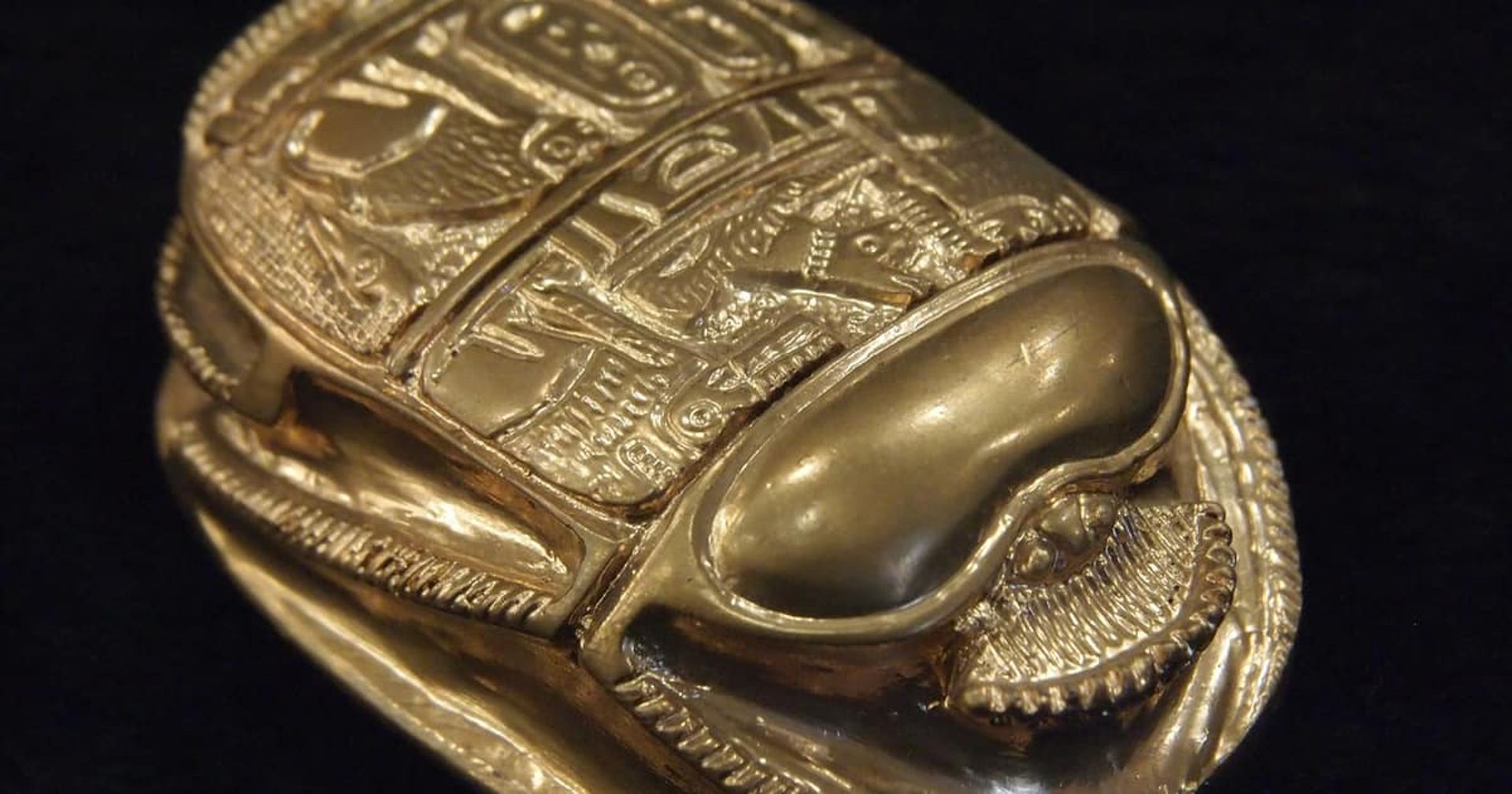
What is scarab jewelry in ancient Egypt?
Scarab jewelry in ancient Egypt is jewelry shaped like a scarab beetle and worn as a sign of protection, rebirth, and spiritual power. The form appears in rings, pendants, bracelets, seals, and burial amulets, and it stayed meaningful for thousands of years across Egyptian society.
The scarab was not treated as a simple insect ornament. Ancient Egyptians connected it with the sun, creation, and the hope of life after death, so a small carved beetle could carry religious meaning as well as personal identity.
Why was the scarab so important in ancient Egypt?
The scarab mattered because ancient Egyptians saw it as a symbol of renewal. The dung beetle rolls a ball across the ground, and that movement matched the way Egyptians imagined the sun traveling each day, which gave the scarab a direct link to rebirth and the rising sun.
Egyptians tied the scarab to Khepri, the god of the rising sun. That connection turned scarab jewelry into a visible reminder of daily renewal, divine order, and the idea that life continued beyond death.
- Renewal and transformation
- Protection from harm
- Eternal life
- The soul’s passage into the afterlife
Who wore scarab jewelry?
Scarab jewelry was worn by kings, nobles, priests, officials, and ordinary Egyptians. The form crossed social lines, although the materials and quality changed with status. Gold scarabs signaled wealth and rank, while simpler faience pieces could belong to many different people.
Pharaohs used scarabs to reinforce divine authority. Priests wore them in religious settings, officials used scarab seals in administration, and everyday people wore scarabs for luck, safety, fertility, and protection.
What materials were used for scarab jewelry?
Ancient Egyptian artisans made scarab jewelry from several materials, depending on purpose and status. Faience was the most common, while steatite, gold, lapis lazuli, carnelian, and turquoise also appear in surviving examples.
Faience scarabs were widely accessible and often had a bright glazed surface. Gold scarabs usually belonged to the elite, and stone or semi-precious versions gave wearers a way to combine faith, style, and social standing in one object.
- Faience, a glazed ceramic material
- Steatite, a soft stone often used for carving
- Gold for high-status pieces
- Lapis lazuli, carnelian, and turquoise in finer jewelry
What is a heart scarab?
A heart scarab is a funerary amulet placed on or near the chest of the dead. Ancient Egyptians believed the heart would be weighed in the afterlife, so the heart scarab acted as spiritual protection during judgment.
Many heart scarabs carried inscriptions from the Book of the Dead asking the heart not to speak against the person who had died. That made the object both jewelry and a ritual tool, designed for burial rather than daily wear.
How were scarabs used as jewelry and seals?
Scarab pieces were worn as rings, pendants, necklaces, and bracelets, but they also worked as seals. Craftspeople often carved the base with names, gods, royal cartouches, or protective signs, then pressed the scarab into clay or wax to mark ownership and authority.
That dual use helped the scarab move between private belief and public life. One object could protect the wearer, identify an official, and communicate status in a single impression.
Why do travelers still care about scarab jewelry today?
Travelers still care about scarab jewelry because it is one of the clearest symbols of ancient Egypt, and it is easy to spot in museums, tomb displays, and temple collections. The object is small, but the story behind it is broad: religion, power, burial practice, and craft all meet in one form.
Visitors who travel through Egypt with curated museum time get the best view of scarab pieces. Cairo and Luxor are strong places to look for examples, especially when a guide explains the inscription, material, and burial context instead of treating the piece as a souvenir.
How should you look at scarab jewelry in a museum?
Scarab jewelry makes more sense when you look at the shape, the underside, and the setting. The top often copies the beetle body, while the base may carry names, spells, or symbols. A guide can help you tell a daily-wear scarab from a funerary scarab in seconds.
- Check the base for inscriptions
- Look for signs that it was a seal or an amulet
- Ask whether the piece came from a burial context
- Notice the material, since faience and gold usually tell different stories
Can you still buy scarab jewelry in Egypt?
Yes, travelers can still buy modern scarab jewelry in Egypt, and many markets and shops sell replicas in different materials. Those pieces can be attractive souvenirs, but they are not ancient artifacts. Museum examples remain the best way to understand the original meaning and use.
A good rule is simple: buy for memory, study for history. Modern scarab jewelry can be a useful keepsake, but its value is different from an object that was actually made and worn in ancient Egypt.
Plan with us
Ancient Egyptian Scarab Jewelry: Meaning, Symbolism, and Power
Learn what scarab jewelry meant in ancient Egypt, how it was worn, and where travelers can still see it today.