
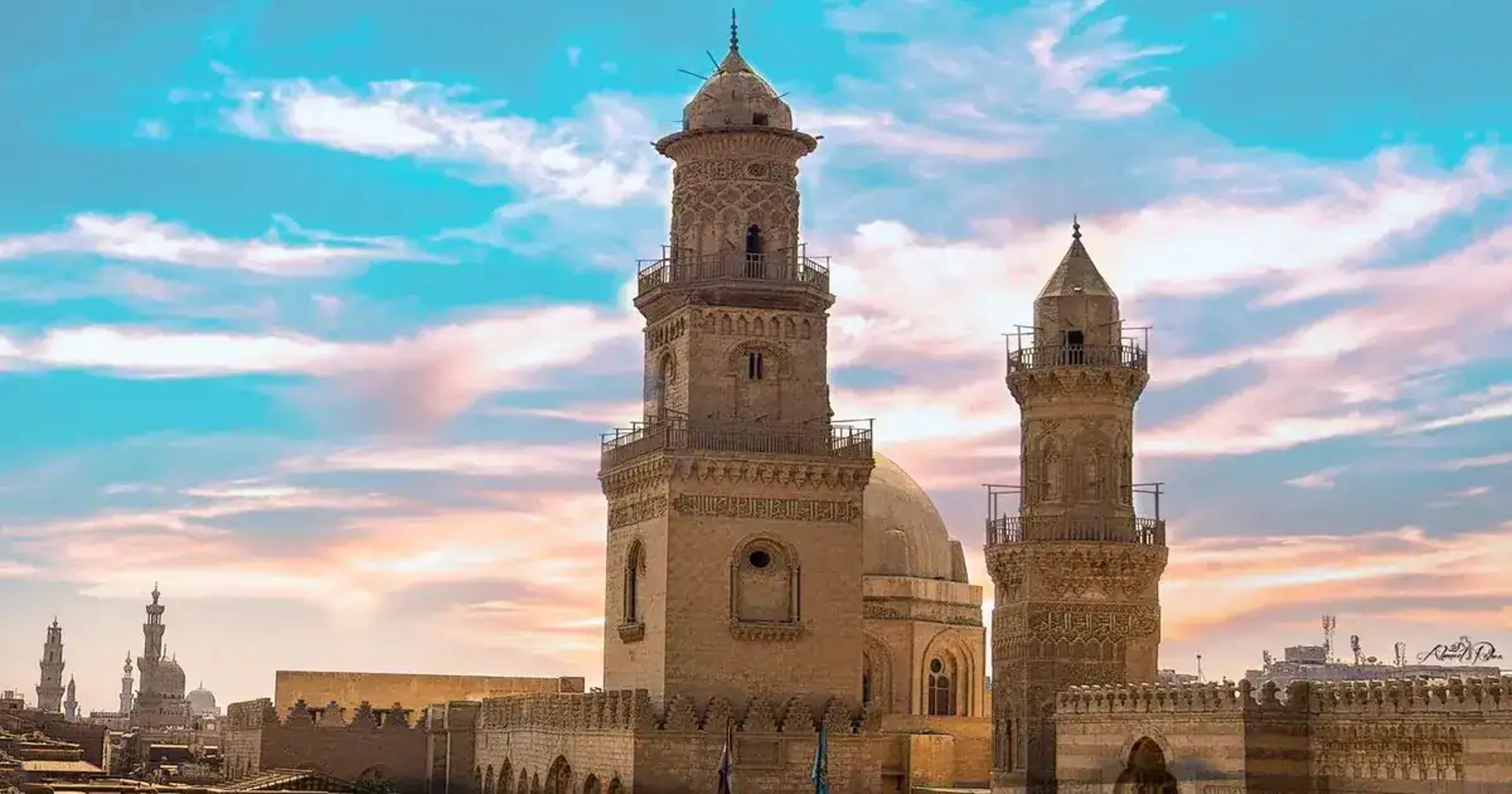
What is Ahmad Ibn Tulun Mosque?
Ahmad Ibn Tulun Mosque is a major early Islamic mosque in Cairo, completed in 879 CE. The mosque stands in the Sayyida Zaynab district of historic Cairo and is known for its large scale, plain brick construction, and unusual spiral minaret. Travelers visit it for architecture, history, and a quieter pace than many Cairo sites.
The mosque of Ahmad Ibn Tulun was built for the new capital of Al-Qata'i, which Ibn Tulun founded after becoming Egypt’s governor in 868 CE. The original city no longer survives, but the mosque remains as one of the clearest links to Egypt’s early Islamic period.
Who was Ahmad ibn Tulun?
Ahmad ibn Tulun was a Turkish military commander appointed by the Abbasid Caliphate to govern Egypt in 868 CE. He later ruled with growing independence, founded the Tulunid dynasty, and built Al-Qata'i as his administrative capital. The mosque was part of that political project as well as a place of prayer.
Ibn Tulun wanted a mosque large enough for Friday prayers for the new capital. Completed in 879 CE, the building became the religious center of Al-Qata'i and has survived for more than 1,100 years with much of its original structure still visible.
Why is the mosque of ibn Tulun important?
The mosque of ibn Tulun is important because it shows early Islamic architecture in a form that still feels clear and readable today. UNESCO describes it as one of the finest surviving examples of early Islamic architecture outside Iraq, and that comparison makes sense once you walk through the courtyard and arcades.
The building is also important because Cairo later filled with heavily decorated mosques from the Fatimid, Mamluk, and Ottoman periods. Ahmad Ibn Tulun Mosque comes from an earlier style, so it helps you see how Islamic architecture in Egypt began before later ornament became the norm.
What does the mosque look like inside?
Inside, Ahmad Ibn Tulun Mosque feels open and orderly. The mosque has a vast courtyard, pointed arcades, brick pillars, and stucco details that catch the light without overwhelming the eye. The scale is the first thing most visitors notice, then the calm atmosphere that comes from the wide open space.
The prayer hall surrounds the courtyard, and the qibla wall marks the direction of Mecca. A mihrab on that wall marks the prayer direction, while the central ablution fountain sits in the courtyard as part of later restoration work. The layout is simple, but the symmetry gives the site a strong visual rhythm.
What is special about the spiral minaret?
Ahmad Ibn Tulun Mosque is famous for its spiral minaret, which is one of the most recognizable features in Islamic Cairo. The tower resembles the Malwiya minaret of Samarra in Iraq, and the exterior staircase wraps around the structure in a striking way that is rare in Egypt.
Visitors can climb the minaret for wide views over historic Cairo, including rooftops, domes, and other minarets. The climb is one reason many travelers remember this mosque more than larger and more crowded sites nearby.
How do you visit Ahmad Ibn Tulun Mosque?
Ahmad Ibn Tulun Mosque is easy to visit as part of a Cairo sightseeing day. The mosque sits in the Sayyida Zaynab district, not far from the Citadel, so many travelers combine it with nearby Islamic Cairo landmarks. Taxi access is the simplest option, and guided tours make the route easier to organize.
The mosque is typically open during the day, and an early visit usually gives you softer light and fewer people. Modest dress is expected, and you should remove your shoes before entering prayer areas. If you want photos, morning is usually the best time for cleaner light inside the courtyard.
- Plan about one hour if you want time for the courtyard and minaret.
- Wear clothing that covers shoulders and knees.
- Bring small cash for any entrance-related needs or services that may come up locally.
- Pair the visit with the Citadel or the Gayer-Anderson Museum.
What should you see near the mosque?
The area around Ahmad Ibn Tulun Mosque works well for a compact Islamic Cairo route. The Citadel of Saladin, the Gayer-Anderson Museum, and older streets around the mosque all fit into the same sightseeing day. The neighborhood gives you a good sense of Cairo’s layered history without long transfers between stops.
The Gayer-Anderson Museum is especially useful if you want to compare mosque architecture with domestic architecture from a later period. The museum sits in two restored Ottoman houses and adds a different angle to the same part of Cairo.
Is Ahmad Ibn Tulun Mosque worth visiting?
Ahmad Ibn Tulun Mosque is worth visiting if you want a historic Cairo site that feels spacious, quiet, and different from the more ornate mosques elsewhere in the city. The building gives you a clear look at early Islamic design, and the spiral minaret makes the visit memorable.
Travelers interested in architecture, Islamic history, or photography usually get the most from a stop here. The mosque also works well inside a broader Cairo day plan because it sits near other major landmarks and does not require a long visit.
Plan with us
Ahmad Ibn Tulun Mosque guide
Plan a visit to Ahmad Ibn Tulun Mosque in Cairo with history, architecture, minaret access, and practical travel advice.