
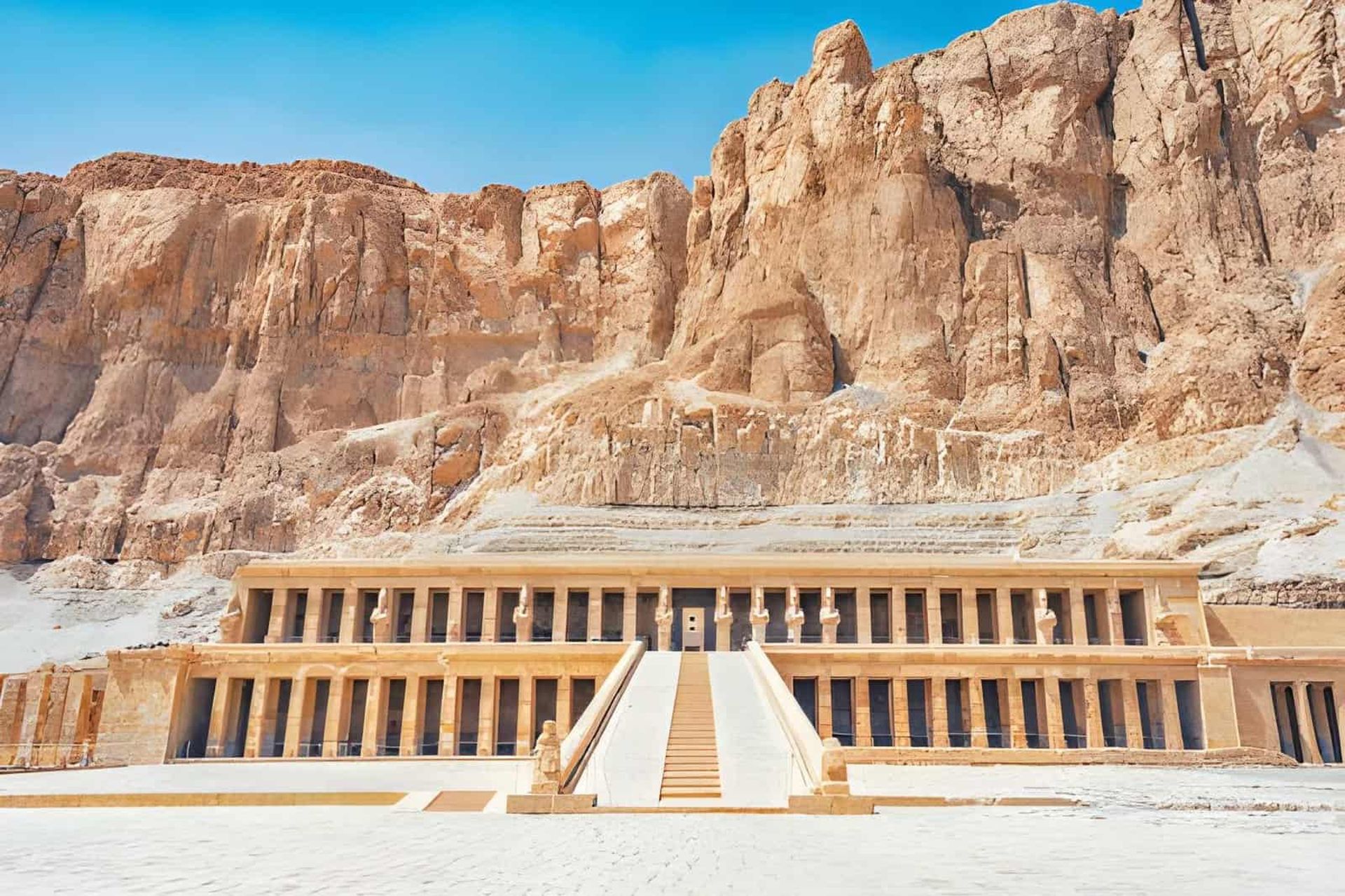
What is the mortuary temple of Hatshepsut?
The mortuary temple of Hatshepsut is a royal temple on Luxor’s West Bank, built at Deir el-Bahari for ritual offerings and posthumous worship. Travelers recognize it fast by its terraces and cliff backdrop. The site is one of Egypt’s most readable ancient monuments because the layout makes the royal message plain.
The temple stands apart from the crowded tombs in the nearby Valley of the Kings. Its setting, symmetry, and scale show why Hatshepsut used architecture to explain power. The monument still feels deliberate and formal, but it is easy to move through on a guided visit.
Who was Queen Hatshepsut?
Queen Hatshepsut was one of the most successful rulers of ancient Egypt’s 18th Dynasty. She was the daughter of Thutmose I and the wife of Thutmose II. After Thutmose II died, she first ruled as regent for the young Thutmose III, then declared herself Pharaoh.
Her reign is usually dated to around 1479 to 1458 BCE. Hatshepsut used full royal titles and kingship imagery, including the false beard and royal kilt seen in statues and reliefs. Her rule is linked with peace, trade, and major building projects, and this temple is the clearest surviving example.
Why was the temple built at Deir el-Bahari?
The temple was built at Deir el-Bahari because the site had royal meaning before Hatshepsut chose it. The location on the West Bank of Luxor connected her monument with earlier rulers and with the burial world beyond the Nile. The placement also gave her temple a direct visual link to the cliffs behind it.
Ancient Egyptian mortuary temples were used for offerings, rituals, and memory, not for the burial itself. Hatshepsut’s temple also worked as political messaging. The divine birth scenes and sacred spaces told visitors that her rule had divine support.
What does the temple of Hatshepsut architecture look like?
The temple of Hatshepsut architecture is built around three terraced levels joined by long ramps. The plan is direct, open, and highly symmetrical. That structure is what makes the site so memorable in Luxor, especially when the afternoon light cuts across the colonnades.
Lower terrace, middle terrace, and upper terrace each have a different focus. The lower level once held gardens and exotic trees said to come from Punt. The middle level contains the best known reliefs, and the upper terrace leads to the sanctuary dedicated to Amun-Ra.
- Lower terrace: open forecourt and the area linked to gardens
- Middle terrace: reliefs, chapels, and the best story scenes
- Upper terrace: sanctuary area and the highest ceremonial space
What should you look for inside the mortuary temple of queen Hatshepsut?
The mortuary temple of queen Hatshepsut is best read through its reliefs, chapels, and terrace views. The most important scenes show her divine birth, her expedition to Punt, and her connection to Amun. Those images explain how Hatshepsut wanted Egyptians to see her reign.
The middle terrace also contains chapels dedicated to Hathor and Anubis. Hathor’s chapel matters because she was tied to music, motherhood, and the west. Anubis appears in funerary spaces because he is linked with embalming and protection for the dead.
- The divine birth reliefs show Amun visiting Hatshepsut’s mother in disguise
- The Punt reliefs show ships, foreign goods, and incense trees
- The chapels of Hathor and Anubis add religious depth to the middle terrace
Where was Hatshepsut buried?
Hatshepsut was buried in a tomb in the Valley of the Kings, not in her mortuary temple. Her burial place is usually identified as KV20. The temple at Deir el-Bahari was for rituals, offerings, and royal memory, while the tomb handled the physical burial.
Travelers often mix up the temple and the tomb because both are on Luxor’s West Bank. The easiest way to separate them is simple: the temple is the public mortuary monument, and the Valley of the Kings is the burial ground.
How long does a visit take?
A visit to the mortuary temple of Hatshepsut usually takes about one to two hours. That is enough time to walk the terraces, study the main reliefs, and take photos from the lower courtyard. Many West Bank itineraries pair the temple with other nearby sites in the same day.
The best pacing is to arrive early, before the heat builds on the open terraces. The site is manageable for most travelers, but shade is limited and the limestone setting reflects strong sun. Good walking shoes, water, and a hat make the visit easier.
What else should you see on Luxor’s West Bank?
Luxor’s West Bank works best as a cluster of sites, not a single stop. The mortuary temple of Hatshepsut is usually combined with the Valley of the Kings, the Colossi of Memnon, and Medinet Habu. That combination gives you a fuller picture of royal burial, worship, and monument building.
Discovery Tours Egypt includes the site in guided West Bank touring, which helps because the monuments connect well when explained together. A local Egyptologist guide also helps you read the reliefs instead of just walking past them.
- /attractions/ for more Egypt sites and tickets
- /day-tours/ for guided Luxor day trips
- /Egypt-tours/ for longer Egypt itineraries
Why does the temple still matter today?
The temple still matters because it shows how one ruler used architecture to shape memory. After Hatshepsut’s death, many images were defaced, likely under Thutmose III, but the building survived. That survival makes the monument an important record of politics, religion, and royal image-making.
Modern restoration, including work by Polish archaeological missions since the 1960s, has helped preserve the site for visitors. The temple is also part of Ancient Thebes with its Necropolis, a UNESCO World Heritage area, which explains why it remains one of Luxor’s major stops.
Plan with us
Mortuary Temple of Queen Hatshepsut Guide
Plan a visit to Hatshepsut’s mortuary temple in Luxor. Learn the history, layout, what to see, and how to fit it into a West Bank day.