
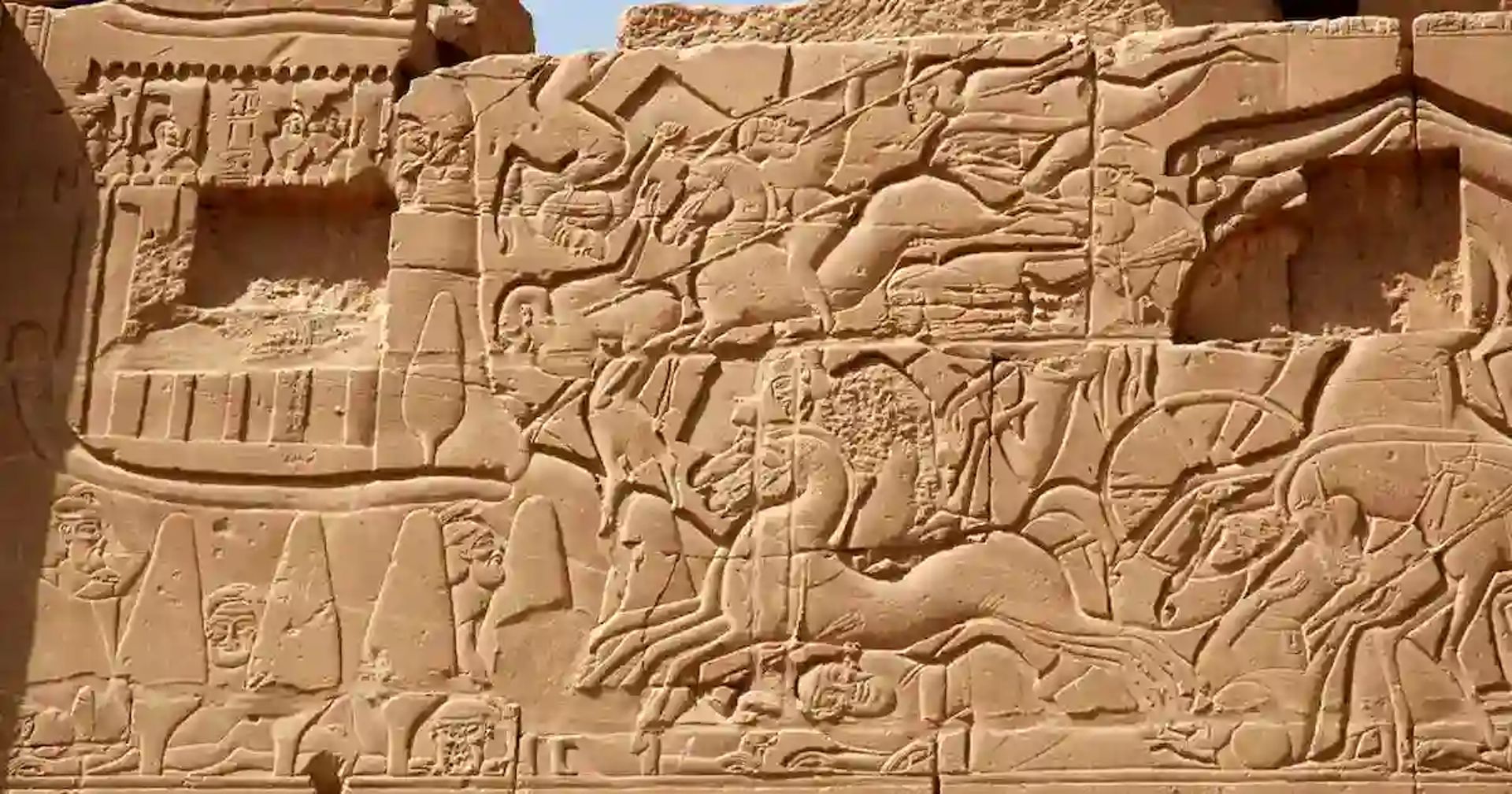
What is Egypt military art and where did it appear?
Egypt military art is carved representation of battles and royal campaigns, most often executed as bas-relief on temple and tomb walls. These scenes appear across major temple sites, especially from the New Kingdom period when Egyptian rulers mounted campaigns into Nubia and the Levant.
Bas-relief means figures project slightly from the stone background, which produces strong modeling under sunlight. You will find the clearest, largest battle programs at Karnak Temple in Luxor, the Abu Simbel temples, the Ramesseum, and Medinet Habu. Each site places military scenes where priests, officials, and visiting worshippers would see the king as a warrior and a religious figure.
Why did Egyptians carve war scenes?
Egyptians carved war scenes to present the Pharaoh as the defender of Ma'at, the cosmic order, and to record royal action in a public, religious setting. Carvings served political, religious, and archival functions at the same time.
Temples acted like public archives and ritual centers, not museums. A carved campaign told visitors who held power, how the king acted under divine sanction, and which enemies had been defeated. Relief programs often exaggerate outcomes, showing the Pharaoh much larger than his foes to express authority rather than give a balanced chronicle.
What techniques and tools did carvers use to make these reliefs?
Carvers used bronze and copper chisels, stone hammers, and a proportion grid to transfer drawings to stone. The work required master artisans and apprentices, who first incised outlines and then cut the low relief to catch shadow.
After carving, painters often added pigment to the relief, though much original color has weathered. The combination of shallow carving and paint let the images read clearly in strong sunlight. Expect to see parallel tool marks, planning lines, and changes where an artist adjusted a figure, evidence of a workshop process rather than a single hand.
What weapons and equipment do the reliefs show?
Reliefs show a consistent set of weapons and military gear: two-wheeled chariots, composite bows, bronze swords, shields, spears, and various polearms. These details make scenes useful to historians studying technology and tactics.
Look for the khopesh, a curved chopping sword frequently carved, as well as chariot teams and the crew positions. At Battle of Kadesh depictions, artists carved horses, chariot fittings, and archers in action. The figures also show formation hints, such as spearmen in ranks and archers firing from chariots.
How do you read a Pharaoh relief carving?
Start with size and placement: the Pharaoh is larger than other figures to indicate status. Read left to right for action, unless captions suggest otherwise, and note accompanying hieroglyphic captions that name places or enemies.
Check for divine figures, who often appear blessing a king. Also note exaggerated gestures, such as a king seizing enemies by the hair or raising a mace. Those gestures communicate authority and ritual victory. Compare repeated scenes across walls to see how the same victory is stressed in different contexts.
Where are the best places to see these carvings today?
Karnak Temple and Luxor hold large programs by Seti I and Ramses II. Abu Simbel records Ramses II with colossal statues and carved battle scenes. The Ramesseum contains Battle of Kadesh reliefs, and Medinet Habu shows Ramses III fighting the Sea Peoples.
Plan visits so you can compare sites. A single guided day can cover parts of Luxor and the Ramesseum, while Abu Simbel requires a separate trip because of its location. Discovery Tours Egypt runs Egyptologist-led visits that connect these sites and explain inscriptions, iconography, and the political message behind each program.
What should I know when I visit a war relief site?
Arrive early for soft light that reveals carved depth, or stay late for strong shadows that emphasize relief texture. Wear comfortable shoes, bring water, and allow time to read hieroglyphic captions with your guide.
- Best months: October to April for cooler weather and more comfortable touring.
- Timing: early morning for even light; late afternoon for deeper shadows on raised carving.
- What to look for: size hierarchy, weapon types, chariot wheels and fittings, and names in hieroglyphs.
- Photography: shoot from an oblique angle to capture texture, and zoom in on weapon details and inscriptions.
Guided interpretation matters. An Egyptologist guide will read place names, identify gods, and explain why the same battle is shown in multiple registers. Discovery Tours Egypt offers Egyptologist-guided options that include site context and translation of key captions.
Can I see reconstructions or reenactments of Pharaoh battle scenes?
Some sites and cultural events stage sound-and-light shows or reenactments that dramatize temple reliefs. These modern performances use lighting, narration, and actors to interpret carved scenes for visitors.
Check schedules before you go. Sound-and-light programs run at selected temples and can help you visualize the carved action, but they are a theatrical interpretation rather than an archaeological record.
Plan with us
Egypt military war carvings, what they show and where to see them
How Egypt military scenes were carved, what they mean, and where to see bas-relief battle art at Karnak, Abu Simbel, Ramesseum, and Medinet Habu.