
Image: Panoramic view of ancient Egyptian temples along the Nile (hero image).
There are places that stop you in your tracks – not from effort, but from pure wonder. Ancient Egyptian temples do that. Standing before hieroglyphs carved thousands of years ago or beneath columns that feel like they hold up the sky, you sense both the weight of time and the ingenuity of a civilization that wrote its stories in stone.
Why Ancient Egyptian Temples Matter
Temples were not community centers in a modern sense but the literal houses of the gods – Hwt‑Ntr, the “House of the God.” Priests cared for divine statues, performed daily rituals and managed vast temple resources. Every element – layout, orientation and decoration – carries symbolic meaning, encoding theology, politics and cosmology. Many temples were aligned to solar events or star risings, and their stone surfaces were once brightly painted to animate myths and ceremonies.
To understand these sites, think in layers: ritual and royal power, sophisticated engineering and urban roles, plus centuries of reuse – Egyptian, Greco‑Roman, Christian and Islamic – that produce the layered landscapes you’ll see today.
Major Temples to Visit
Karnak (Luxor) – A Sacred City in Stone
Karnak is the largest religious complex ever constructed, a sequence of pylons, courts and sanctuaries added to over two millennia in honor of Amun‑Ra and other deities. The Great Hypostyle Hall – a forest of colossal columns – is the site’s showpiece, its walls covered in carved scenes and remnants of original color. Walk the ancient Avenue of Sphinxes toward Luxor Temple and imagine festival processions. Ongoing archaeology continues to uncover buried sections, reminding visitors that there’s always more to learn.
Image: Aerial view of ancient Egyptian temples at Karnak complex in Luxor, Egypt.
Luxor Temple – Religion, Kingship and a City Above
Luxor Temple emphasizes the rejuvenation of kingship rather than dedication to a single god. Buried over time beneath the growing city, it incorporates a mosque within its stones – a vivid example of Egypt’s layered history. The temple takes on special atmosphere at night when parts are illuminated. Move from the riverfront colonnades through the pylons toward the sanctuary and you’ll encounter statues, obelisks and reliefs that trace successive rulers.
Image: Aerial view of ancient Egyptian temples at Luxor complex in Luxor, Egypt.
Abu Simbel – Carved Into the Cliff
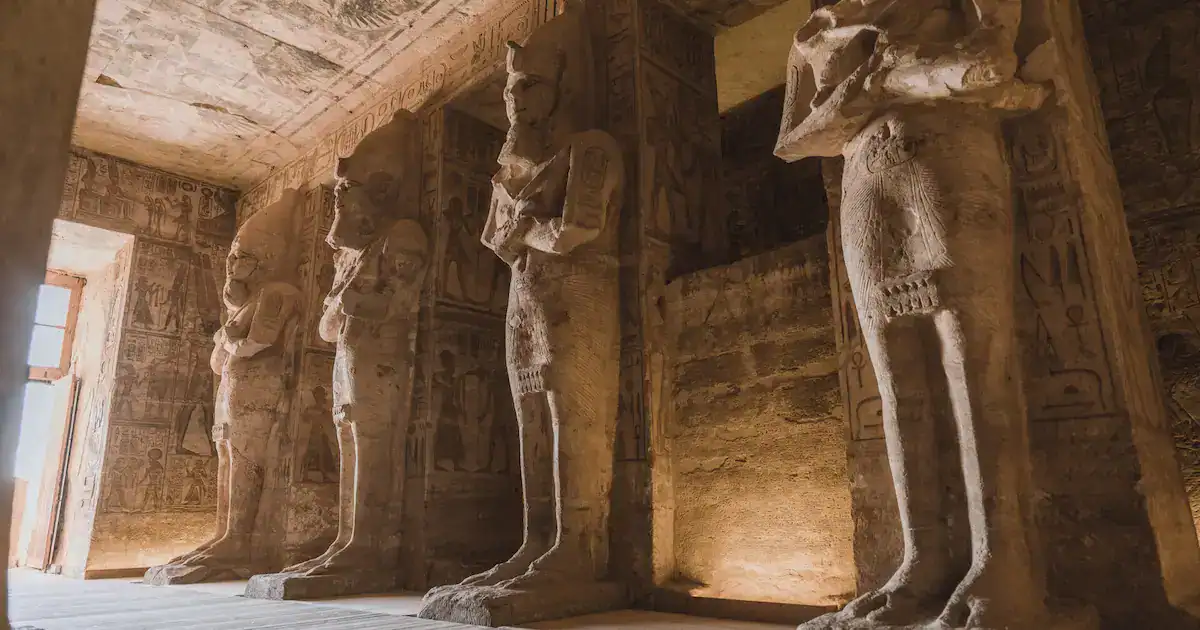
Abu Simbel’s rock‑cut façade, with colossal seated figures of Ramesses II, is among Egypt’s most powerful monuments. In the 1960s the temples were carefully dismantled and relocated to higher ground to protect them from Lake Nasser – a landmark UNESCO conservation project. The interior alignment that allows sunlight to reach the sanctuary on specific days shows the builders’ astronomical skill. If you plan an Abu Simbel visit, check current access details and seasonal schedules before you travel.
Image: Colossal statues of Ramesses II at Abu Simbel, one of the most iconic ancient Egyptian temples.
Image: Abu Simbel – Egypt’s most dramatic temple.
Philae, Hatshepsut, Edfu, Kom Ombo and Medinet Habu – Highlights and Why They Matter
Philae, relocated and rebuilt on Agilkia Island, was the last major center of the cult of Isis and remains one of the most romantic temple sites, reached by boat from Aswan. Hatshepsut’s mortuary temple at Deir el‑Bahari is an architectural masterpiece set into a cliff. Edfu’s Temple of Horus is exceptionally well preserved – its Ptolemaic inscriptions offer a clear look at ritual practice. Kom Ombo’s unusual double layout honors both Sobek and Horus and includes a local museum with crocodile mummies. Medinet Habu, the mortuary temple of Ramesses III, stands out for its expansive battle reliefs and fortress‑like entrance.
Practical Planning & Logistics
Organizing sites in a geographic sequence saves travel time and deepens the experience. A common route is to base yourself in Luxor for both East and West Bank sites, then follow the Nile corridor south to Edfu, Kom Ombo and Aswan, with an Abu Simbel excursion available from Aswan. Many travelers combine a Nile cruise or river segment with land transfers. Work with Egypt travel specialists – an Egypt‑based tour operator with offices in Cairo, Luxor, Aswan, Hurghada, Marsa Alam and Sharm El Sheikh and IATA‑accredited partners – so you have reliable local support from arrival through departure. For travelers from the US, typical departures include JFK, IAD, SFO, ORD and LAX, often with overnight transit via FRA, IST or DXB; plan for jet lag from EST and allow a buffer day on arrival.
Always check current site access and transportation details before you go. Conservation rules sometimes close upper chambers or restrict areas for preservation. Also review CDC travel guidance and any health advisories, and request up‑to‑date accessibility information and local assistance in advance if you have mobility concerns.
How to Experience the Temples – Tips That Make a Difference
- Timing: aim for sunrise or late afternoon for softer light, cooler temperatures and fewer crowds. Night illuminations at Luxor and Philae can be atmospheric – check schedules.
- Guides: hire a licensed Egyptologist guide for deeper context; a knowledgeable guide turns inscriptions into narratives and brings scenes to life.
- Pace: give each major site time – Karnak and Luxor deserve hours, not minutes. Resist the urge to rush through a checklist.
- What to bring: sun protection, a refillable water bottle, a small flashlight for dark interiors, comfortable walking shoes and a respectful layer for shoulders and knees.
- Photography: follow signage and your guide’s instructions. Don’t touch painted reliefs or climb on ancient structures.
Sample Routes & Day Plans
A few reliable travel patterns: spend multiple days in Luxor to cover Karnak, Luxor Temple, Hatshepsut and nearby tombs; combine a Nile cruise or river segment with stops at Edfu and Kom Ombo en route to Aswan and Philae; and reserve a day (or an overland night) for Abu Simbel from Aswan. If time is limited, prioritize based on your interests – monumental architecture (Karnak, Abu Simbel), ritual and inscription (Edfu, Kom Ombo), or setting and landscape (Philae, Deir el‑Bahari).
Conservation, Respect and Responsible Travel
Temples are fragile archives. Vibration from heavy foot traffic, body oils and careless touching damage painted surfaces and delicate reliefs. Follow site rules, listen to guides, and avoid touching walls. Support official conservation efforts where possible and consider small donations through authorized channels – respectful behavior helps preserve these monuments for future generations.
FAQ – Quick Answers
Are there Egyptian temples outside Egypt?
Yes. Several authentic ancient Egyptian temple structures were relocated in the 19th and 20th centuries and are displayed abroad – the Temple of Debod in Madrid and the Temple of Dendur at the Metropolitan Museum of Art in New York are two well‑known examples. Such relocations were often part of international preservation collaborations.
How do temples differ from tombs?
Temples were active religious centers staffed by priests who ran rituals and managed temple wealth. Tombs – like those in the Valley of the Kings – were funerary spaces meant to protect burials and aid the afterlife. Both can be richly decorated, but their functions and ancient access rules were very different.
Final Thoughts – Why You Should Go
Ancient Egyptian temples rank among the world’s most moving places: architectural feats, theological texts in stone and living sites woven into modern communities. Whether your interest is architecture, archaeology, photography or quiet reflection, plan with experienced Egypt travel specialists, allow time to move slowly through the sites, and consider local support so logistics are effortless. With the Grand Egyptian Museum newly open (2026) and strong on‑the‑ground partners, you can focus on the stones and the stories they hold.
Plan with us
Ancient Egyptian Temples: The Complete Guide to Egypt’s Sacred Wonders
Explore Egypt’s temples–what to see, when to visit, route ideas and practical accessibility tips. Plan your trip from the US with Discovery Tours Egypt and expert local support.