
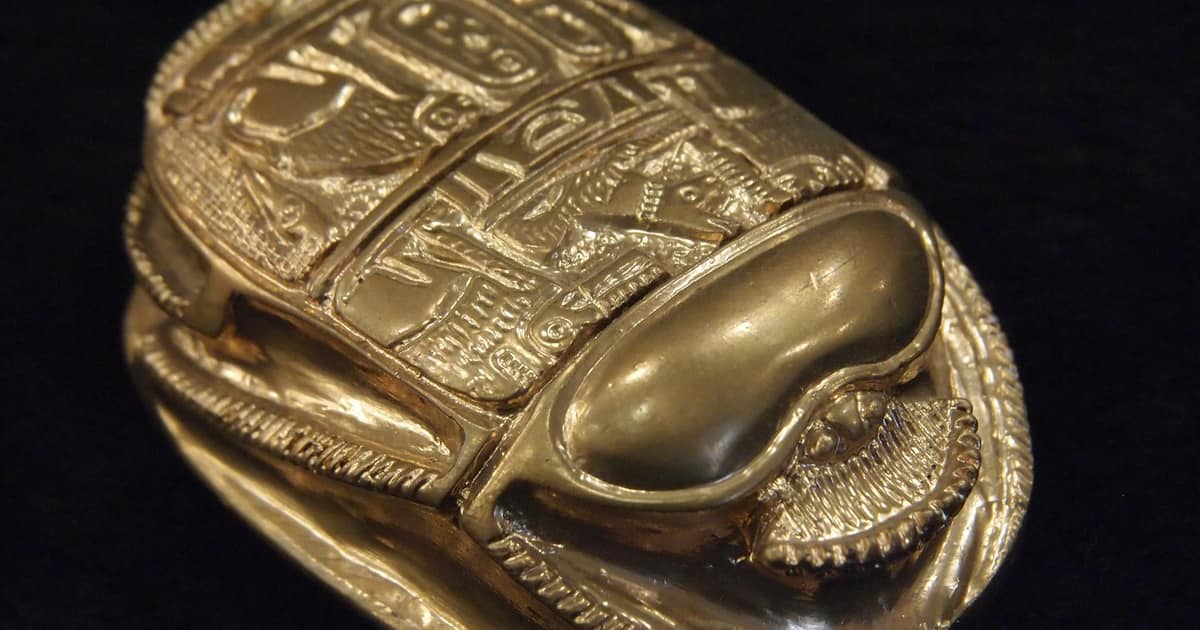
Small, carved, and often brightly glazed, scarab beetle amulets are among the most instantly recognizable objects from ancient Egypt. Worn as rings and pendants or placed over the heart in burials, scarabs layered meanings of protection, rebirth, and official authority–serving as both personal jewelry and powerful religious symbols.
Image: Ancient Egyptian scarab jewelry hero image
Origins and Religious Symbolism
Image: Origins and Religious Symbolism
The beetle behind these amulets is the dung beetle (Scarabaeus sacer). Ancient observers watched it roll a ball and lay eggs inside, seeing a vivid parallel with the sun’s daily rebirth. That association linked the scarab to Khepri, the morning form of the sun god who renews life each dawn, and made the motif a natural emblem of cosmic renewal used for everyday protection and funerary rites.
Scarab imagery appears from the Middle Kingdom onward and remained popular for centuries. Forms and functions evolved, but the central idea of regeneration endured, which is why scarabs were adopted across social classes and used in both jewelry and ritual objects.
Types and Functions of Scarab Jewelry
Image: Types and Functions of Scarab Jewelry
Heart Scarabs and Funerary Amulets
One distinct variety is the heart scarab: a larger amulet placed over the chest of the deceased and often inscribed with funerary spells meant to silence the heart during judgment in the afterlife. Because of their size and inscriptions, heart scarabs bridge jewelry-making and ritual protection and provide archaeologists with clear clues about beliefs around death and moral accountability.
Image: Ancient Egyptian scarab jewelry amulet
Seals, Personal Amulets, and Status Symbols
Not all scarabs were funerary. Many were small seals with intaglio inscriptions on the flat underside, used by officials to stamp clay on property, letters, or records. Others served as everyday talismans–rings, beads, or bracelets–valued for protection and aesthetic appeal. Material, size, and carving complexity often signaled the wearer’s social rank or administrative role.
Materials, Craftsmanship, and Inscriptions
Ancient artisans worked with a surprisingly wide palette. Faience–a glazed, silica-based ceramic–was widely available and produced blues and greens linked to rebirth. Steatite (soapstone) was commonly used as a core and glazed after carving. Higher-status scarabs might be set in gold or inlaid with lapis lazuli, carnelian, or turquoise; material choices carried both practical and symbolic meaning.
Image: Ancient Egyptian scarab jewelry in gold and gemstones
The underside of many scarabs records names of gods, royal cartouches, protective formulas, and decorative motifs. Carving and glazing techniques improved over time, and archaeologists use stylistic changes, tool marks, and chemical tests to date and source pieces. Because scarabs doubled as seals, their inscriptions can also provide direct historical evidence–names of officials, offices, or places.
Scarab Jewelry in Tombs and Archaeological Context
Image: Scarab Jewelry in Tombs and Archaeological Context
Excavations have recovered scarabs from tombs, temples, homes, and administrative sites. In burial assemblages they commonly appear alongside other amulets, shabti figures, and funerary texts–parts of a ritual toolkit intended to secure safe passage for the deceased. When you see scarabs in museums, the find context and associated objects make a big difference in understanding their function.
If you plan to see scarabs in Egypt, prioritize regional collections and major museums–collections in Cairo and Luxor frequently include standout pieces. Always check exhibition details before travel: artifacts move between museums on loan and special displays rotate.
Modern Reproductions, Collecting, and Authentication
Because scarabs have long appealed to collectors and travelers, both fine modern reproductions and genuine ancient scarabs appear on the market. Reproductions–from well-made jewelry to inexpensive souvenirs–can be beautiful and ethical keepsakes. Genuine ancient scarabs are cultural heritage items; trading in unprovenanced antiquities raises legal and ethical concerns.
Authentication Tips
When an object is offered as “ancient,” ask for provenance: clear ownership history, museum deaccession records, or export paperwork. Look for natural patina, consistent wear patterns, and period-appropriate tool marks–experts also use microscopic and chemical analysis to separate ancient work from modern fakes or artificially aged pieces. For serious purchases, get an independent appraisal from a recognized institution or accredited specialist.
Buying Advice and Ethical Considerations
If you want a scarab to wear, consider commissioning a high-quality modern reproduction from local Egyptian craftsmen or reputable jewelers. Buying replicas supports artisans and avoids contributing to the illicit antiquities trade. If you are offered an “ancient” piece, request written provenance and a receipt, check export and customs rules, and remember many genuine artifacts cannot legally leave Egypt. When in doubt, choose a certified replica labeled clearly.
Photography and Imagery Suggestions
For close-up photos of scarabs, use a macro lens or your phone’s close-focus mode, diffuse lighting to reduce glare on glazed surfaces, and shoot multiple angles–especially the underside and any inscriptions. Museums may restrict flash or close-up work; always follow display rules and conservation guidelines. High-resolution images are useful for study and for experts assessing authenticity.
Travel Tips and Where to See Scarabs
To view scarabs in context, prioritize museums with well-documented collections and regional institutions near key archaeological sites. Cairo and Luxor collections often offer compelling displays; regional museums in places like Aswan and around the Valley of the Kings can add important local perspectives. Confirm current exhibition listings in advance–displays and loans change regularly.
Traveling with an IATA-accredited Egypt-based tour operator or Egypt travel specialists can open curator-led visits, behind-the-scenes access, and thematic museum tours focused on jewelry and funerary equipment. Our Egypt travel specialists operate from a Cairo HQ with regional offices in Luxor, Aswan, Hurghada, Marsa Alam, and Sharm El Sheikh to help connect museum visits, site tours, and local craft encounters.
Conclusion: Why Scarabs Continue to Captivate
Scarab jewelry compresses ancient Egyptian cosmology into a wearable form–an emblem of the sun’s rebirth, a seal of identity, and a portable amulet of protection. Whether you see a weathered heart scarab in a museum case or a polished modern reproduction in a Cairo workshop, these objects offer a direct link to beliefs that shaped one of the world’s longest-lived civilizations. See them in context and buy responsibly to enrich your visit.
Further Resources & Practical Reminders
For deeper study, consult museum catalogs, peer-reviewed work on Egyptian glyptics, and conservation departments at major collections. If you plan to purchase or ship antiquities, check legal and customs requirements, ask dealers for full documentation, and review CDC travel guidance before departure. For site visits and specialist-led experiences, contact Egypt travel specialists who can arrange curator talks, access to storerooms, and responsible craft workshops. Confirm all details before travel.
Plan with us
Ancient Egyptian Scarab Jewelry: Meaning, Uses, and Cultural Power
Explore meanings, materials, funerary uses, and buying tips for ancient Egyptian scarab jewelry. Plan US-friendly visits to Cairo’s Grand Egyptian Museum (2026) and regional collections.