
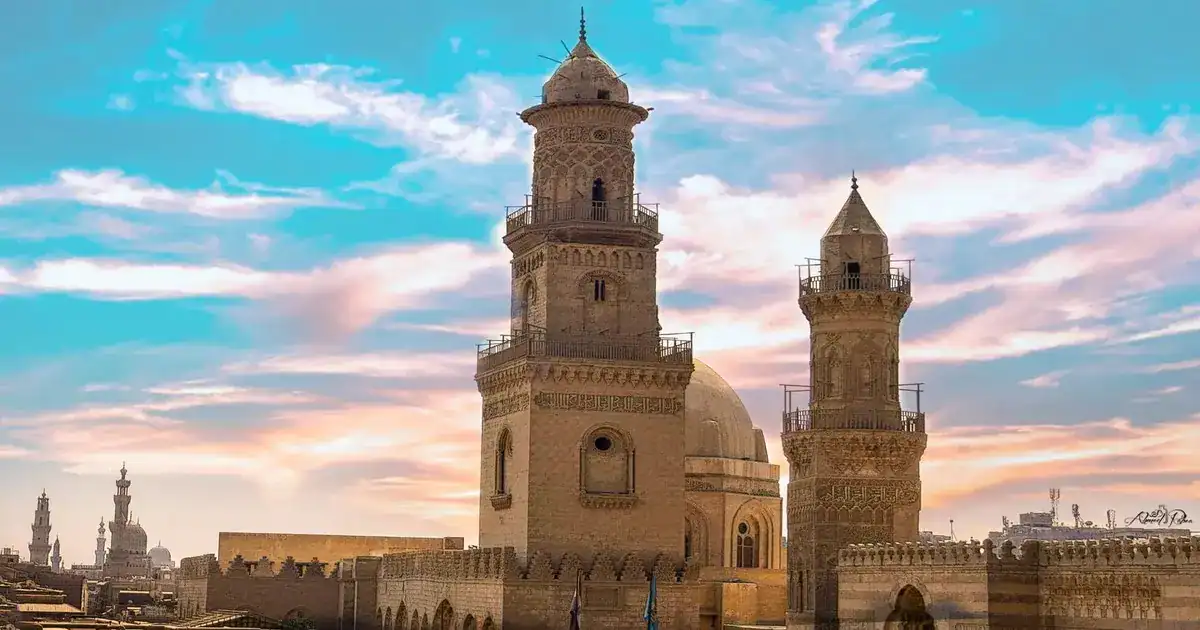
Hero image: wide exterior view of the Ahmad Ibn Tulun Mosque in Cairo.
Cairo layers eras on top of one another, and the Ahmad Ibn Tulun Mosque is one of the city’s best-preserved survivors from the early Islamic period. Built in the 9th century, it reads as a coherent complex: a large courtyard framed by arcades, a tiered prayer hall, and a spiral minaret that recalls major Abbasid monuments.
This practical guide covers the mosque’s history and design, visitor essentials and photography pointers, plus simple itinerary ideas so you can make the most of a stop in Islamic Cairo.
Image detail: intricate arches and geometric stucco work at the Ahmad Ibn Tulun Mosque.
A short history of Ahmad Ibn Tulun Mosque
The mosque was commissioned by Ahmad ibn Tulun, a Turkish commander who rose to be governor of Egypt under the Abbasids and founded the Tulunid dynasty. He laid out a new administrative quarter, Al‑Qata’i, placing the mosque at its civic and religious center. Finished in the late 9th century, the complex served both state and worship functions and survives with much of its original plan and fabric intact.
Historically the mosque matters because it brought Abbasid architectural ideas into Egypt. Instead of reusing heavyweight stone columns from older temples, builders worked with baked brick, stucco and repeated, restrained forms to achieve a monumental scale–an approach more typical of the Iraqi world at the time.
Architectural highlights
Abbasid influences and materials
The mosque’s planning–courtyards, rhythmic arcades and stucco ornament–shows a clear relationship to the Abbasid heartland, including Samarra. The main construction materials are brick and plaster; decorative stucco panels and carved motifs give delicate surface patterning rather than heavy figural carving. The architecture depends on proportion, repetition and the play of light for its effect.
The spiral minaret
The mosque’s spiral minaret is its signature silhouette. The external ramp and cylindrical tower recall the famous Malwiya at Samarra, making the mosque instantly recognizable on Cairo’s skyline. When access is permitted, climbing the minaret rewards visitors with layered views of domes and minarets that trace the city’s development–access can change, so check current details before you go.
Plan, courtyard and spiritual logic
At heart the mosque is a tightly ordered rectangle. Wide outer yards (ziyadas) separate the sacred enclosure from the surrounding streets, while the central sahn (courtyard) organizes movement and daylight. The prayer hall, oriented toward Mecca, contains a mihrab that anchors ritual focus. Repeated arches and bays create a meditative rhythm that reflects early Islamic priorities: unity, order and proportion over lavish ornament.
Image: the timeless courtyard of Ahmad Ibn Tulun Mosque with its spiral minaret.
Visiting: transport, access and behavior
The mosque sits in historic Cairo and is straightforward to reach from central neighborhoods. Most visitors arrive by taxi or ride‑hailing app, and many include the mosque on curated Cairo city tours arranged by Egypt travel specialists. If you’re traveling independently, allow extra time for traffic and for navigating the neighborhood’s narrow streets.
Opening hours, entry procedures and access to areas such as the minaret can change for religious services or conservation work. Always check current details before you travel so you arrive at a suitable time and avoid surprises.
- Dress modestly: cover shoulders and knees–bring a scarf if needed.
- Remove shoes where requested inside prayer areas and respect any gender‑specific access rules.
- Be mindful during prayer times–non‑Muslim visitors should avoid interrupting worship.
- Carry water and wear comfortable shoes; expect uneven surfaces in the courtyard and surrounding streets.
Image detail: close-up of the mosque’s carved stucco and arch geometry.
Photography and what to shoot
The mosque is a photographer’s dream: its scale, repeating geometry and the way light falls across stucco and brick give endless compositional opportunities. Pair wide shots of the courtyard with close-ups of carved panels and arch details to capture both the monumental and the intimate.
- Shoot the courtyard wide to show scale; include people for scale when appropriate.
- Use a telephoto or zoom to isolate stucco patterns and mihrab details.
- Visit at golden hour (early morning or late afternoon) for warm, angled light and strong tonal contrast.
- Avoid flash in prayer areas and always ask permission before photographing worshippers or private spaces.
Nearby sights and itinerary tie‑ins
Ahmad Ibn Tulun sits within a compact historic district that rewards a half‑day of exploration. It pairs easily with the Citadel and the Gayer‑Anderson Museum, plus the maze‑like streets of Islamic Cairo where small workshops and cafés bring the area to life. The newly opened Grand Egyptian Museum (2026) is also a major draw and can be added to a fuller Cairo day.
- Start at Ahmad Ibn Tulun to take in the courtyard and, if open, the minaret.
- Walk or ride a short distance to the Gayer‑Anderson Museum for Ottoman domestic interiors.
- Head on to the Citadel for sweeping views, then explore nearby bazaars in Islamic Cairo.
If you’re planning a longer Egypt trip, Egypt travel specialists can combine a Cairo city program with visits to Luxor, Aswan or Red Sea resorts. Whether you’re departing from major US gateways (JFK, IAD, SFO, ORD, LAX) with common overnight connections through FRA, IST or DXB, our Cairo‑based team (Cairo HQ plus offices in Luxor, Aswan, Hurghada, Marsa Alam and Sharm El Sheikh) can arrange private guides, transfers and seamless connections so the mosque visit fits neatly into your broader itinerary.
Practicalities and respectful behavior
Security checks or conservation work sometimes affect access at historic sites in Cairo. Allow extra time, carry identification, and verify the latest visitor information before you travel. Respectful behavior–speaking quietly, avoiding intrusive photos during worship, and following staff instructions–helps keep the mosque welcoming for worshippers and visitors alike.
Plan with us
Ahmad Ibn Tulun Mosque – History, Architecture & Visiting Guide
Explore the 9th-century Ahmad Ibn Tulun Mosque in Cairo–Abbasid architecture, photo tips and practical visiting advice. Plan from US gateways and add the Grand Egyptian Museum to your trip.