
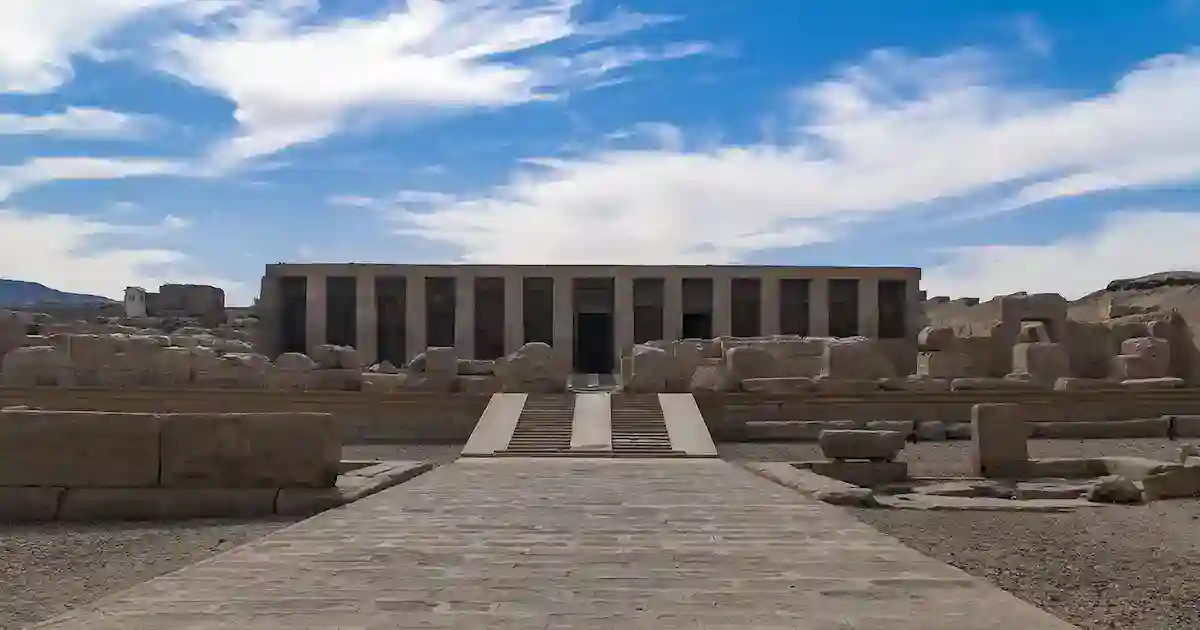
Hero image: Abydos Temple Egypt – exterior view.
For millennia Abydos was more than a temple: it was the spiritual center of devotion to Osiris, god of death and rebirth. Pilgrims came from across the Nile Valley to perform rites, set up stelae and seek a closer connection to eternity. Today the quiet courtyards, crisp reliefs and the subterranean Osirion still convey that same sense of sacred purpose.
The Sacred History of Abydos
The myth of Osiris and the rise of Abydos
Abydos gained its sacred status through the Osiris myth: a god murdered by his brother, reassembled by Isis and reborn as ruler of the afterlife. Ordinary Egyptians believed that proximity to Osiris mattered–being buried near Abydos or dedicating a cenotaph there could help secure a favorable destiny after death. Over the centuries thousands of stelae and votive monuments accumulated around the temple, creating a deeply personal archaeological record of pilgrimage.
Seti I, Ramses II and the temple we see today
The core building visitors walk through was commissioned by Seti I in the late 13th century BCE and completed in part by his son, Ramses II. Unlike many complexes that accumulated layers across eras, Seti’s temple remains unusually coherent–its relief work is widely admired as one of the finest surviving examples of New Kingdom craftsmanship.
Architecture and Relief Highlights
L-shaped layout and sanctuaries
Abydos breaks with the typical straight axial plan: its interior bends into an L-shaped sequence of chapels and sanctuaries. This design allowed Seti I to house multiple side sanctuaries–each with a distinct cult focus–within one cohesive monument. As you move through the spaces the scale shifts from open courtyards to intimate sanctuaries, and the relief subjects and finish adapt accordingly.
Image: detailed relief carvings inside Abydos Temple Egypt.
Relief quality and the Abydos King List
The relief carvings at Abydos are remarkably crisp. Seti’s workshops produced finely incised scenes of the king making offerings, ritual sequences and funerary iconography. One of the temple’s most important elements is the Abydos King List: a carved sequence of rulers presented as an official royal genealogy. For historians it’s an invaluable, if selective, tool for reconstructing ancient chronologies; for visitors it’s a striking example of how the past was recorded and curated by its makers.
The Osirion: Mystery Beneath the Sand
What the Osirion is like
Behind the main temple sits the Osirion, a partly subterranean structure that early archaeologists described as archaic and enigmatic. Massive stone blocks form a central raised platform surrounded by channels that once held water. Dim, cool and otherworldly, the Osirion contrasts sharply with the sunlit courtyards above and reinforces the site’s funerary and regenerative symbolism.
Image: Osirion temple in Abydos Egypt – ancient stone structure.
Symbolism and archaeological debate
Scholars continue to debate the Osirion’s origins and precise purpose. The dominant interpretation ties it to Seti I’s program, reading the water channels and central platform as symbolic of the primordial waters and the tomb of Osiris–an architectural theater of death and regeneration. Whether older foundations lie beneath or the design intentionally evokes an archaic aesthetic, the Osirion remains one of Upper Egypt’s most evocative sights.
Why Abydos Was Central to Pilgrimage
Abydos worked as a spiritual destination where public ritual and private devotion met. Festivals that reenacted Osiris’s death and resurrection drew pilgrims who left inscriptions, offerings and small monuments. Those traces turn the site into a communal memory bank–an accumulation of private hopes, official ritual and royal imagery. For modern visitors that blend of personal and political religion is a large part of Abydos’s emotional power.
Visiting Abydos Temple Today
Getting there and practicalities
Abydos sits in Upper Egypt and is most commonly visited from Luxor as a long day trip or as part of an Upper Egypt itinerary. Public transport to the site is limited, so many travelers prefer private transfers or organized excursions. If you want help arranging transport or a guided visit, Egypt travel specialists and Egypt-based tour operators with offices in Cairo, Luxor, Aswan, Hurghada, Marsa Alam and Sharm El Sheikh can coordinate logistics and local guides. Always check current details and health guidance before you travel.
Best time to visit and pacing
Early morning visits give softer light on the reliefs and usually fewer visitors. The site is outdoors and largely unshaded, so plan for sun and heat depending on the season–many US travelers prefer cooler months or shoulder seasons such as late fall, winter and spring (think Thanksgiving, winter break or spring break windows). Allow time to move slowly: Abydos rewards patience–study a single chamber or relief in depth rather than rushing through.
Practical Travel Tips & Conservation Notes
A knowledgeable local guide will point out subtle scenes, explain ritual context and direct you to the King List and the Osirion. If you travel independently, download an authoritative site guide or carry a good guidebook to get the most from your visit.
- Wear a hat and sunscreen; shade is limited across the site.
- Bring water and comfortable shoes for uneven stone and steps.
- Do not touch reliefs or climb on monuments–conservation depends on visitor behavior.
- Use a guide or a detailed site map to locate the Abydos King List corridor and the Osirion.
Many travelers combine Abydos with nearby Dendera or other Upper Egyptian sites to create a richer narrative of ancient belief and royal cults. Whether you plan a focused day trip or a longer exploration of the region, Abydos rewards those who step off the busiest routes and linger where the past still feels present.
Plan with us
Abydos Temple, Egypt – Visitor & History Guide
Explore Abydos Temple’s sacred history, Seti I’s reliefs and the enigmatic Osirion. Practical tips for US travelers planning a Luxor day trip or an Upper Egypt itinerary with Discovery Tours Egypt.