
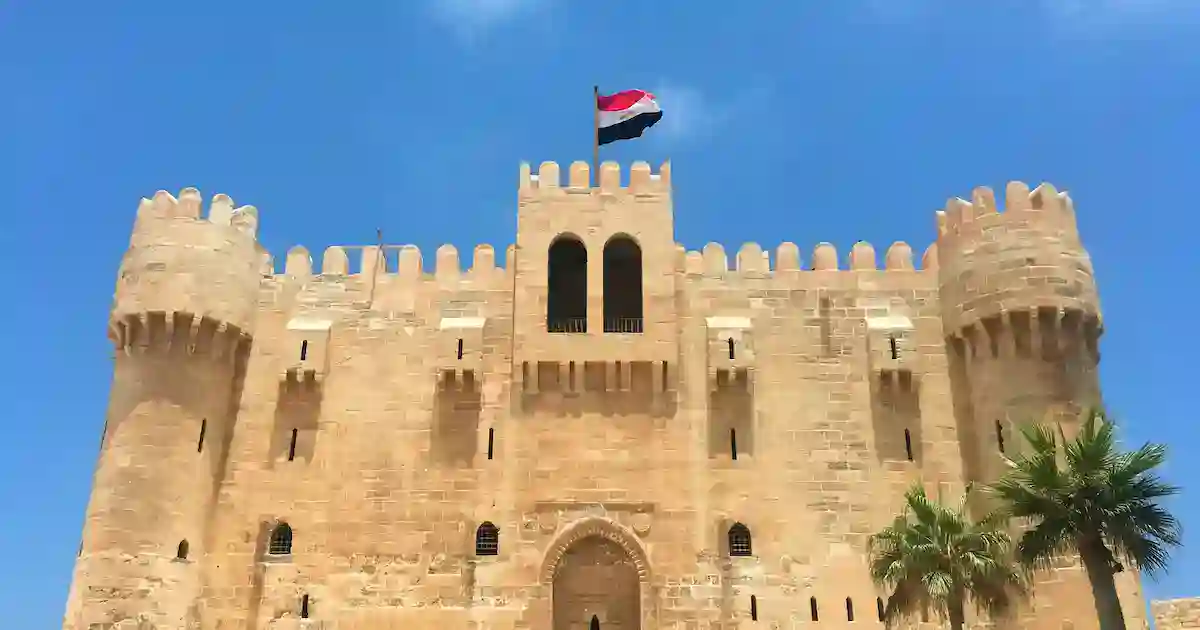
There is a particular kind of magic that happens when you stand at the very tip of Alexandria’s Eastern Harbour, with the Mediterranean crashing on three sides of you and a towering medieval fortress rising above the waves. That place is the Citadel of Qaitbay — one of the most iconic, most photographed, and most historically layered landmarks in all of Egypt. It is the kind of monument that rewards you twice: once with its sheer visual drama, and again with the extraordinary story buried within its walls.
The Citadel of Qaitbay Alexandria Egypt is not simply a beautiful fort by the sea. It stands on the exact site of one of the Seven Wonders of the Ancient World — the legendary Lighthouse of Alexandria — and was itself built using the ruins of that collapsed wonder as its very foundation. Imagine the weight of that history beneath your feet. Every stone you touch may once have been part of the most famous lighthouse in human civilization.
For travelers exploring the treasures of northern Egypt, the Alexandria Citadel of Qaitbay is an unmissable stop — a perfect blend of Mamluk military architecture, Mediterranean drama, and ancient Alexandrian legend. Whether you are planning a day trip from Cairo or building a longer coastal itinerary through our Egypt Tour Packages or Egypt Classic Tours, this fortress deserves a prominent place on your list. Let this guide be your complete companion.
The Weight of History — Background & Context of the Citadel of Qaitbay
To understand why the Citadel of Qaitbay matters so deeply, you have to go back more than two thousand years — to a time when Alexandria was the intellectual capital of the ancient world, home to the Great Library, the Mouseion, and one of the most extraordinary engineering achievements of the ancient age: the Lighthouse of Alexandria, known in Greek as the Pharos.
Built around 280 BCE on the island of Pharos (which has since been connected to the mainland by a natural sandbar called the Heptastadion), the Lighthouse of Alexandria stood between 100 and 137 meters tall — making it one of the tallest man-made structures on earth for centuries. It guided ships safely into Alexandria’s harbor for over a thousand years. Ancient accounts describe a mirror or polished bronze at its summit that reflected sunlight by day and firelight by night, visible from distances of up to 50 kilometers at sea. For the ancient world, it was not merely a practical structure — it was a symbol of Alexandria’s supreme power, learning, and ambition.
The lighthouse was damaged by a series of powerful earthquakes between the 10th and 14th centuries CE, and by the time the Mamluk Sultan Al-Ashraf Sayf al-Din Qaitbay ordered the construction of a defensive fortress on the site in 1477, the ruins of the Pharos were little more than a field of massive scattered stones. Rather than remove them, his builders did something remarkable — they incorporated those ancient limestone and granite blocks directly into the new fortress walls. This means that to visit the Citadel of Qaitbay Alexandria today is to walk among the literal fragments of a lost wonder of the world.
The fortress was completed in 1479 CE — constructed with extraordinary speed for its scale — and has stood as Alexandria’s primary coastal defense for over five centuries. It is recognized today by UNESCO as a landmark of outstanding historical significance and remains one of Egypt’s most visited and beloved historical sites.
Inside the Citadel of Qaitbay — Architecture, Halls, and Hidden Stories
The Exterior — A Fortress Born from the Sea
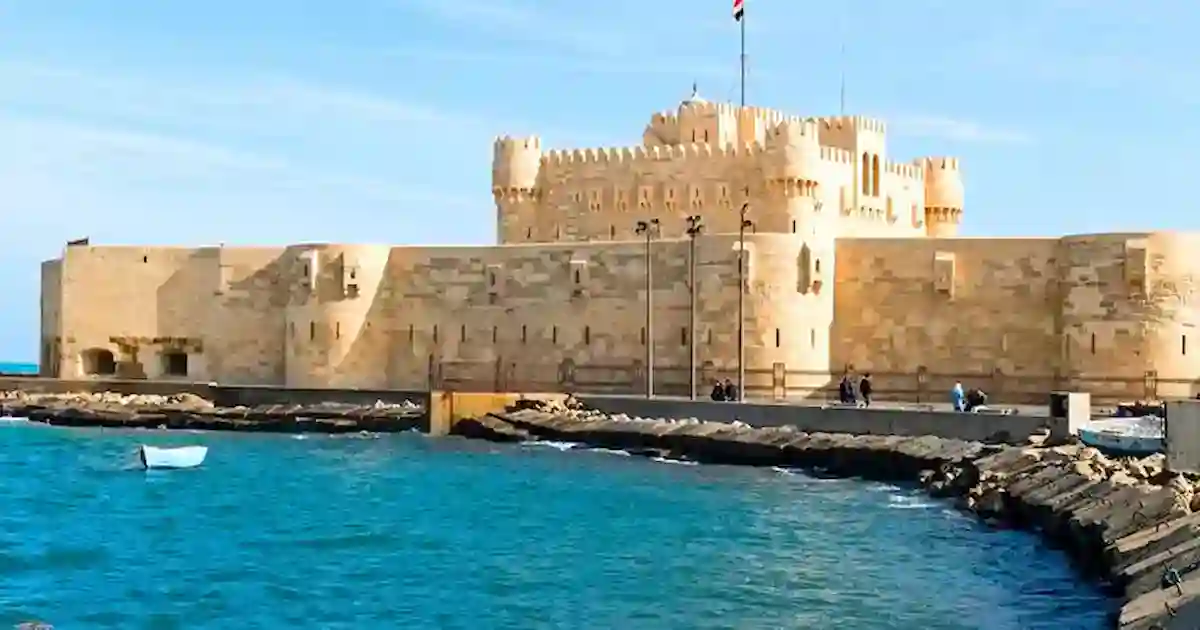
The first sight of the Citadel of Qaitbay from the Corniche is unforgettable. The fortress sits at the end of a narrow peninsula, jutting into the Mediterranean like the prow of a great stone ship. Its outer walls are built from a warm golden-yellow limestone, streaked in places with the darker granite blocks that once belonged to the ancient lighthouse — you can sometimes identify these by their enormous size and slightly different color. The main tower rises approximately 17 meters above the sea level and is crowned by distinctive Mamluk-style battlements and watch towers at each corner.
A wide moat originally surrounded the citadel on the landward side, though it has since been partially filled. The main entrance gate faces south toward the city and is flanked by rounded bastions — classic features of late medieval Islamic military architecture designed to deflect cannon fire and provide overlapping fields of fire for defenders.
The Main Tower — Three Stories of Military History
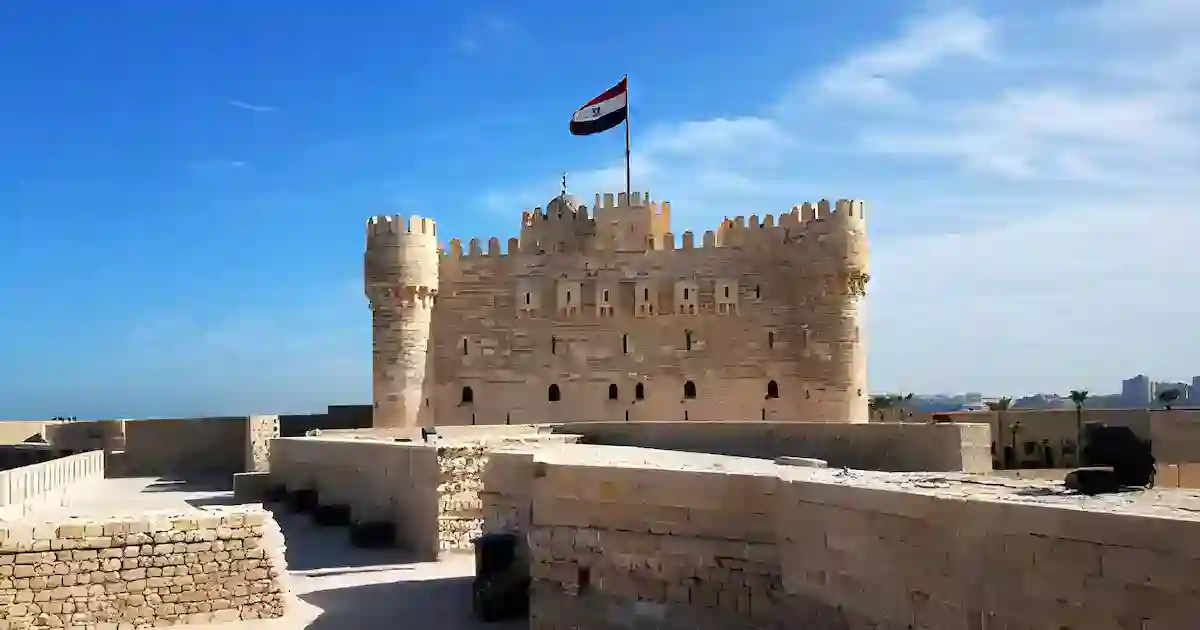
The heart of the Alexandria Citadel of Qaitbay is its great central tower, which rises in three stories above a rectangular base. Each floor served a specific function in the original fortress:
The ground floor housed a mosque — a beautiful, modest space with a single dome and a mihrab (prayer niche) still intact today. The presence of a mosque within the fortress was standard practice in Mamluk architecture, ensuring that soldiers could fulfill their religious duties without leaving the fortified perimeter.
The second floor contained the garrison quarters, storage rooms for weapons and provisions, and a series of vaulted halls where soldiers would sleep and prepare for action. The thickness of these walls — in some places exceeding three meters — gives you a visceral sense of the military seriousness with which this fortress was designed.
The third floor originally functioned as a lookout level and signal station, with wide arched windows overlooking the Mediterranean in every direction. On a clear day, the view from these upper levels stretches to the horizon in a 180-degree arc of blue water that makes you understand immediately why this location was chosen — both for the ancient lighthouse and for the medieval fortress. Nothing could approach from the sea without being seen.
The Naval Museum — A Hidden Gem Within the Walls
Many visitors to the Citadel of Qaitbay Alexandria Egypt are surprised to discover that a branch of the Egyptian Naval Museum is housed within the fortress grounds. The museum displays an impressive collection of maritime artifacts including ancient anchors recovered from Alexandria’s harbor, navigation instruments, model ships spanning different historical periods, and exhibits documenting the naval battles fought in and around Alexandria’s waters from ancient times to the modern era.
The naval museum adds a wonderful additional layer to the visit — especially for travelers interested in maritime history, as Alexandria’s harbor has been one of the busiest and most strategically important in the world for over two millennia.
The Granite Columns and Lighthouse Fragments
As you explore the citadel of qaitbay, look carefully at the lower sections of the outer walls and the rubble fill between the dressed stone facing. You will find enormous granite columns and massive limestone blocks clearly of a different age and style from the 15th-century construction surrounding them — these are the physical remains of the ancient Lighthouse of Alexandria, recycled and repurposed by Qaitbay’s builders. Archaeologists and visitors alike have spent hours identifying these ancient fragments embedded in the medieval walls.
Additionally, in 1994 and the years following, marine archaeologists discovered a remarkable underwater treasure just off the coast of the citadel: hundreds of ancient granite statues, architectural elements, and sphinx figures lying on the seabed in the harbor. These are believed to be remains of the lighthouse and the ancient royal quarter of Alexandria, toppled by the medieval earthquakes. The underwater site at Qaitbay is now considered one of the most significant submerged archaeological sites in the world, and plans for an underwater museum in Alexandria’s Eastern Harbour have been discussed by Egyptian cultural authorities for years.
The Surrounding Area — Alexandria’s Corniche and Eastern Harbour
The Citadel of Qaitbay does not stand in isolation — it is the jewel at the end of Alexandria’s magnificent Eastern Harbour, framed by the sweeping curve of the Corniche road and the city’s seafront. Walking toward the citadel along the harbor promenade is one of the great urban walks in Egypt: fishing boats bob in the water, nets are spread to dry on the quayside, seagulls wheel overhead, and the blue-green Mediterranean stretches endlessly to the north. It is a walk that feels simultaneously ancient and entirely alive.
The area around the fortress is home to several excellent seafood restaurants where visitors can enjoy freshly caught fish with a direct view of the citadel — a combination that is hard to improve upon. A visit to Qaitbay fits beautifully into a full day exploring Alexandria’s historic Eastern Harbour district, which also includes the Bibliotheca Alexandrina (the modern reincarnation of the ancient Library of Alexandria) and the Greco-Roman Museum.
If you want to experience Alexandria as part of a broader Egyptian journey, our Egypt Tour Packages include carefully planned routes that combine Cairo’s pyramids with Alexandria’s coastal wonders in one seamless itinerary.
Practical Tips for Visiting the Citadel of Qaitbay
Planning your visit to the Citadel of Qaitbay Alexandria is straightforward, but a few insider tips will ensure you get the most from the experience.
Citadel of Qaitbay Entrance Fee & Opening Hours:
- The Citadel of Qaitbay entrance fee is very affordable by international standards. As of the most recent available information, entry is approximately EGP 180 for foreign adults and EGP 90 for foreign students (Egyptian nationals pay a lower rate). Prices are subject to annual revision by the Egyptian Ministry of Tourism and Antiquities, so always verify the current fee before your visit.
- The citadel is typically open daily from 9:00 AM to 5:00 PM, with extended hours in summer. Arriving early is highly recommended.
Best Time to Visit:
- Early morning (9:00–11:00 AM) is ideal — the light is soft and golden, the crowds are thin, and the Mediterranean has a mirror-calm quality that produces stunning photographs.
- Late afternoon (3:00–5:00 PM) is equally magical as the sun descends toward the western harbor and turns the fortress walls amber and rose gold.
- Avoid midday in summer (July–August) when temperatures in Alexandria can exceed 35°C (95°F) and the exposed fortress grounds offer little shade.
- October to April is the best season overall — mild temperatures, clear skies, and manageable crowds make for a perfect visit.
Getting There:
- From central Alexandria, the citadel is accessible by taxi (approximately 15–20 minutes from Ramses Square in Alexandria), by tuk-tuk along the Corniche, or on foot if you are already in the Eastern Harbour area.
- From Cairo, Alexandria is reached by comfortable air-conditioned trains (approximately 2–2.5 hours from Ramses Station) or by private car (approximately 2.5–3 hours via the desert highway).
What to Bring:
- Comfortable walking shoes — the fortress floors are uneven stone and can be slippery in places.
- A hat and sunscreen — the citadel is largely exposed to the Mediterranean sun.
- A camera or charged phone — the views from the upper levels are extraordinary and deserve to be documented.
- A small amount of cash for the entrance fee, as card payment is not always available on-site.
Guided Tours vs. Self-Guided:
- The citadel can be explored independently, but hiring a licensed local guide significantly enriches the experience. A good guide will identify the ancient lighthouse fragments, explain the Mamluk architectural features, and bring the medieval history to life through storytelling that no signboard can replicate.
- For travelers on organized itineraries through our Egypt Classic Tours, expert Egyptologist guides accompany you throughout, ensuring you never miss a detail.
Conclusion — The Citadel of Qaitbay Belongs on Every Egypt Itinerary
There are few places in the world where you can stand and feel two entirely different civilizations beneath your feet at once. The Citadel of Qaitbay is one of them — a medieval Mamluk fortress built literally from the bones of an ancient wonder, standing guard over one of the most historic harbors on earth for over five centuries. It is simultaneously a masterpiece of military architecture, a repository of ancient fragments, a working piece of Alexandria’s living identity, and one of the most photogenic locations in all of Egypt.
Whether you come for the history, the sea views, the architectural beauty, or simply the atmosphere of a place where so many layers of human civilization overlap, the Citadel of Qaitbay Alexandria Egypt will not disappoint. It is the kind of landmark that stays with you long after you leave — a silhouette against the Mediterranean sky that you find yourself sketching on napkins months later, wondering when you can go back.
Make it part of your Egyptian journey. Explore our Egypt Tour Packages for complete itineraries that include Alexandria alongside Cairo, Luxor, and Aswan. Or browse our Egypt Classic Tours for curated routes designed to show you the very best of this extraordinary country.
Ready to visit the Citadel of Qaitbay?Contact our travel experts and let us take care of every detail — from Alexandria’s seafront to the temples of Upper Egypt.
Citadel of Qaitbay — Your Questions Answered
Where exactly is the Citadel of Qaitbay located?
The Citadel of Qaitbay is located in Alexandria, Egypt, on the eastern tip of the ancient Pharos Peninsula at the mouth of the city’s Eastern Harbour. It sits right at the edge of the Mediterranean Sea, surrounded by water on three sides, at the northern end of the famous Corniche road. The full address is typically referenced as the Eastern Harbour district of Alexandria, and it is easily accessible from the city center within 15–20 minutes by taxi.
What is the Citadel of Qaitbay entrance fee?
The Citadel of Qaitbay entrance fee for foreign visitors is approximately EGP 180 for adults and EGP 90 for students with valid ID (prices correct as of the most recent update and subject to change). Egyptian nationals pay a reduced rate. The citadel is generally open daily from 9:00 AM to 5:00 PM. It is always advisable to confirm the current ticket price with your tour operator or the official Egyptian Ministry of Tourism website before your visit, as fees are reviewed annually.
What is the historical significance of the Citadel of Qaitbay?
The Citadel of Qaitbay Alexandria is historically significant for two interconnected reasons. First, it was built in 1477–1479 CE by the Mamluk Sultan Qaitbay as a critical coastal defense against Ottoman expansion — part of a broader network of fortifications he constructed along Egypt’s Mediterranean and Red Sea coasts. Second, and perhaps more fascinatingly, it was built on the precise site of the ancient Lighthouse of Alexandria — one of the Seven Wonders of the Ancient World — and was constructed using the lighthouse’s own fallen stones as building material. This makes it one of the most literally layered historical sites on earth.
Can you visit the inside of the Citadel of Qaitbay?
Yes — the interior of the Citadel of Qaitbay is fully open to visitors and offers a rich exploration experience. Inside you will find the three-story central tower with its ground-floor mosque, garrison halls, and upper-level viewing terraces, as well as a branch of the Egyptian Naval Museum displaying maritime artifacts from across different historical periods. The views from the upper levels of the fortress tower — looking out over the Mediterranean and back across Alexandria’s sweeping Eastern Harbour — are among the most spectacular views in Egypt and alone are worth the entrance fee.
How long does it take to visit the Citadel of Qaitbay?
Most visitors spend 1.5 to 2.5 hours exploring the Citadel of Qaitbay Alexandria Egypt, depending on their level of interest in history and photography. A quick visit covering the main tower and exterior walls takes about an hour. Adding the Naval Museum and time spent on the upper terraces enjoying the sea views typically extends the visit to 2 hours or more. We recommend combining your visit to the citadel with a walk along the Eastern Harbour Corniche and lunch at one of the excellent seafood restaurants nearby, turning it into a full and rewarding half-day Alexandria experience. For a complete Alexandria itinerary, our Egypt Tour Packages can be fully customized to suit your schedule.
Further Reading: UNESCO Tentative Heritage List — Alexandria | Egyptian Ministry of Tourism and Antiquities
Explore More: Egypt Tour Packages | Egypt Classic Tours | Contact Our Travel Experts