
Cairo is a city where centuries overlap, where ancient stones whisper stories to anyone willing to slow down and listen. Few places capture this feeling better than the Ahmad Ibn Tulun Mosque. Tucked into the historic district of Islamic Cairo, the Ahmad Ibn Tulun Mosque is one of the oldest and most fascinating mosques in Egypt — and one of the best preserved in the entire Islamic world.
Step through its gates and the noise of Cairo fades away. Inside, the Ahmad Ibn Tulun Mosque Cairo reveals a vast courtyard, elegant arcades, and a spiral minaret unlike anything else in the city. Travelers often describe the experience as stepping back in time.
In this complete guide, you’ll discover the history of the mosque of Ahmad Ibn Tulun, explore its remarkable architecture, and learn practical tips for visiting one of Cairo’s most extraordinary landmarks. If you’re planning to explore Islamic Cairo, this mosque deserves a top spot on your itinerary.
Many travelers include it during curated experiences such as Cairo Day Tours or broader Egypt Day Tours, where expert guides bring the monument’s fascinating story to life.
The Story Behind Ahmad Ibn Tulun Mosque
Who Was Ahmad Ibn Tulun?
The story of the mosque of Ahmad Ibn Tulun in Cairo begins in the 9th century with a powerful governor who reshaped Egypt’s political landscape.
Ahmad Ibn Tulun was a Turkish military commander appointed by the Abbasid Caliphate to govern Egypt in 868 CE. Yet he quickly transformed his role from provincial governor to independent ruler. Over time, he established the Tulunid dynasty and built a new administrative capital called Al-Qata’i.
At the heart of this new city, he commissioned a grand mosque — one that would symbolize both religious devotion and political authority.
Completed in 879 CE, the Ahmad Ibn Tulun Mosque became the spiritual center of the new capital. Remarkably, it has survived more than 1,100 years with much of its original structure intact.
According to historical sources such as UNESCO, the mosque represents one of the finest surviving examples of early Islamic architecture outside Iraq.
Why the Mosque Was Built
Ibn Tulun envisioned a mosque large enough to accommodate the entire population of his new capital for Friday prayers.
The result was a monumental structure covering over six acres — far larger than most mosques of its time. It reflected both spiritual ambition and architectural innovation.
Unlike many Cairo mosques built later in stone, this one used baked brick and plaster, a construction technique inspired by Abbasid architecture in Iraq.
The design created a mosque that was both imposing and surprisingly serene — a place where scale and simplicity coexist beautifully.
Architectural Wonders of the Mosque of Ahmad Ibn Tulun
Walking into the Ahmad Ibn Tulun Mosque Cairo is an architectural experience unlike any other in the city.
The Unique Abbasid Design
The mosque’s architecture draws heavily from the Abbasid style that flourished in Samarra, Iraq.
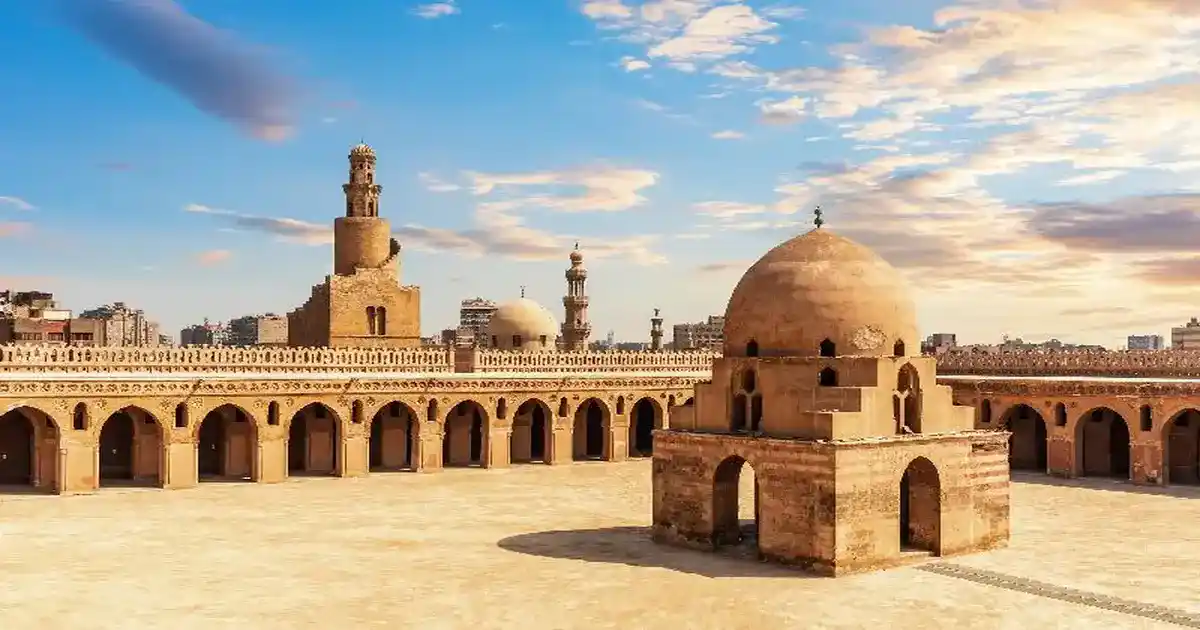
Its vast open courtyard, framed by arcades of pointed arches, immediately stands out. The arches are decorated with subtle stucco carvings — geometric patterns that catch the light in fascinating ways throughout the day.
Instead of marble columns taken from ancient temples — a common feature in many Egyptian mosques — the mosque of Ahmad Ibn Tulun uses brick pillars and plaster decoration.
This approach gives the building a striking visual rhythm. Repetition, symmetry, and space define the aesthetic.
Travelers often remark on the calm atmosphere here. Unlike Cairo’s more crowded mosques, this one feels expansive and meditative.
The Famous Spiral Minaret
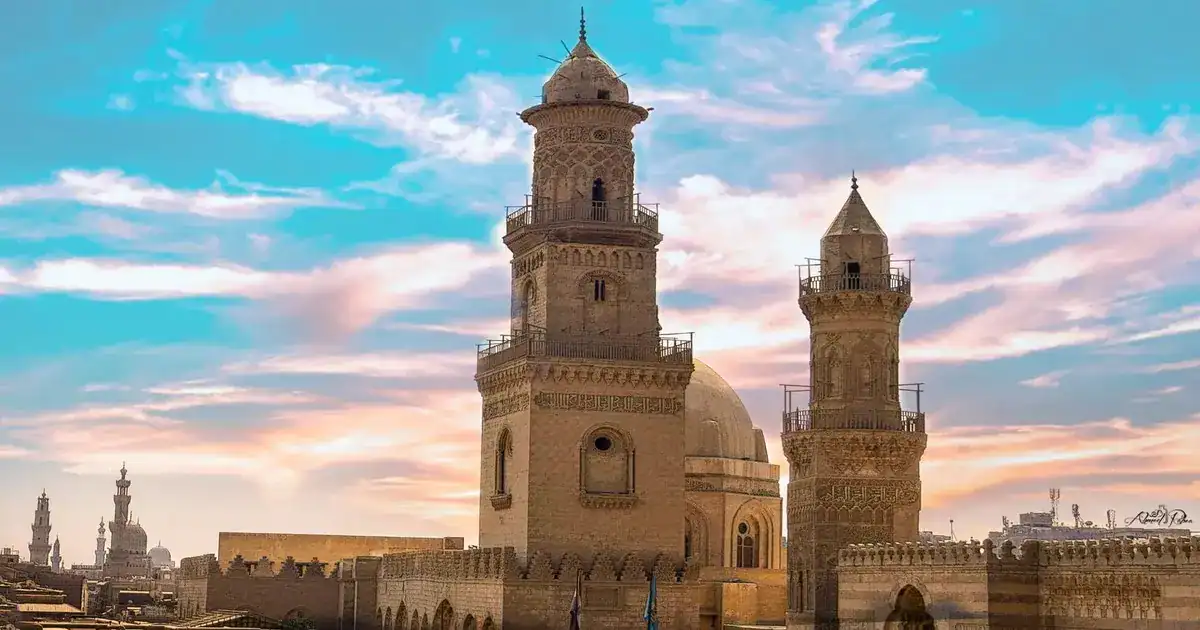
Perhaps the most recognizable feature of the Ahmad Ibn Tulun Mosque is its unusual spiral minaret.
Rising above the mosque complex, the minaret resembles the famous Malwiya tower of Samarra. A staircase wraps around its exterior, allowing visitors to climb to the top.
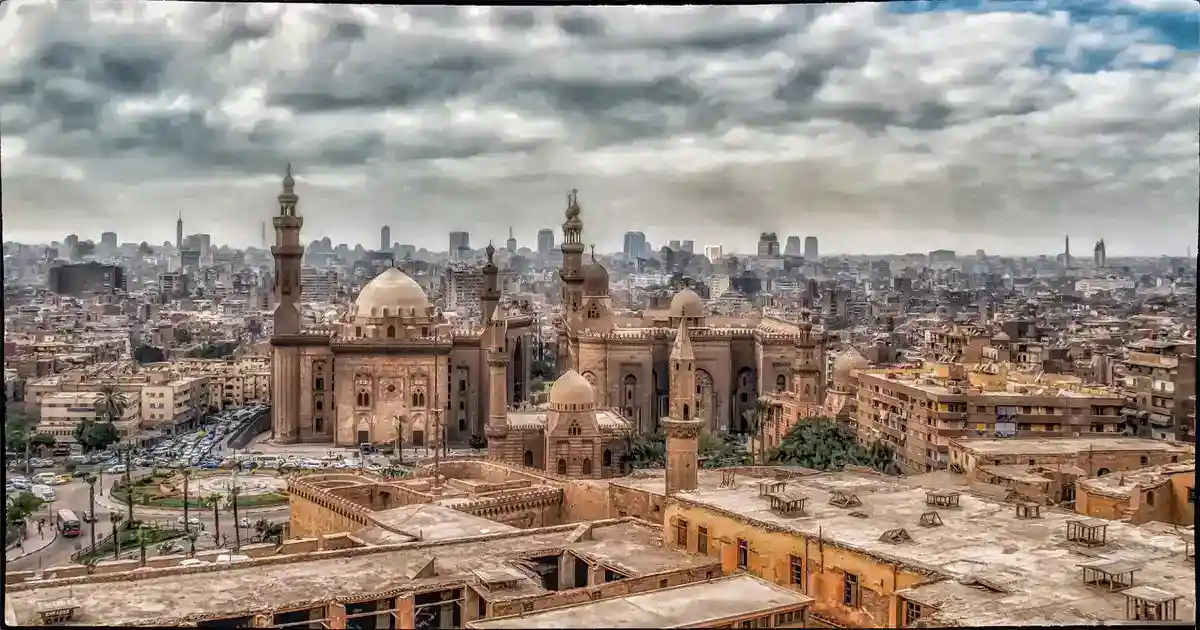
From the summit, the view stretches across historic Cairo — domes, minarets, and rooftops layered across centuries.
Many photographers consider this one of the best panoramic viewpoints in Islamic Cairo.
The Mosque Layout and Courtyard
At the center of the mosque lies a vast open courtyard known as a sahn.
In the middle stands a domed ablution fountain, added during later restorations. Around the courtyard, arcaded prayer halls create shaded walkways that protect worshippers from Cairo’s intense sun.
The scale is remarkable. Even during busy hours, the space rarely feels crowded.
It’s easy to imagine how thousands once gathered here for communal prayer.
For detailed architectural analysis, the Wikipedia page provides extensive historical documentation.
Exploring the Ahmad Ibn Tulun Mosque Plan
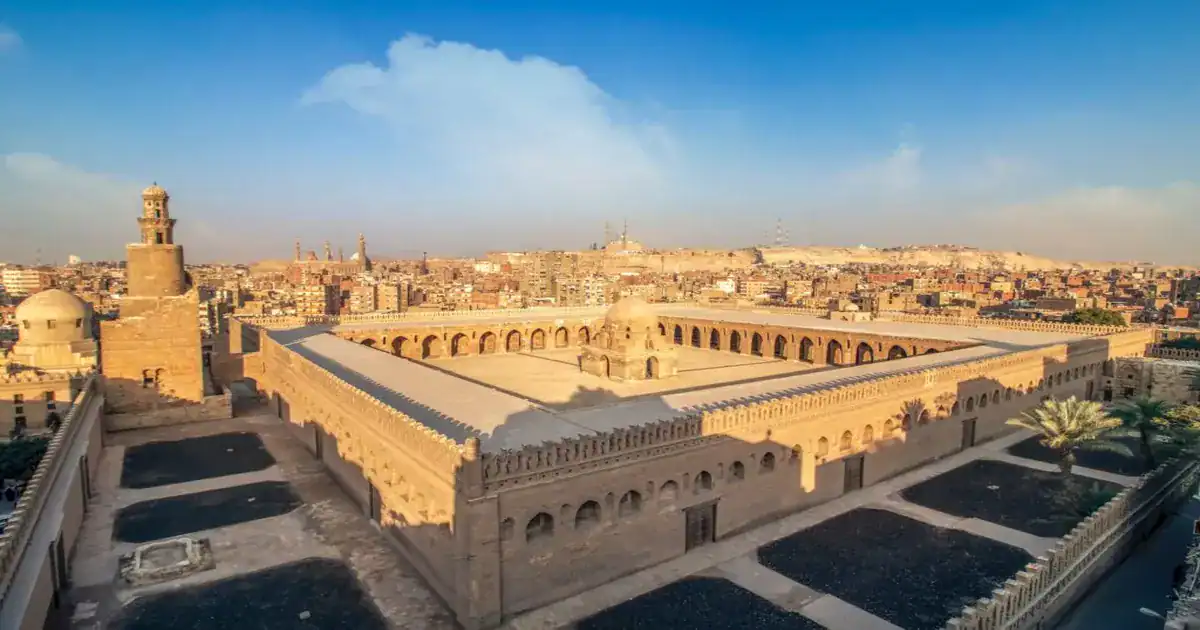
Understanding the Ahmad Ibn Tulun Mosque plan reveals the genius behind its design.
Key Architectural Elements
The mosque follows a rectangular layout surrounded by outer walls and open courtyards called ziyadas.
These outer spaces served practical and symbolic purposes:
- They separated the sacred interior from the city
- They controlled crowd movement during large gatherings
- They provided additional space during major religious events
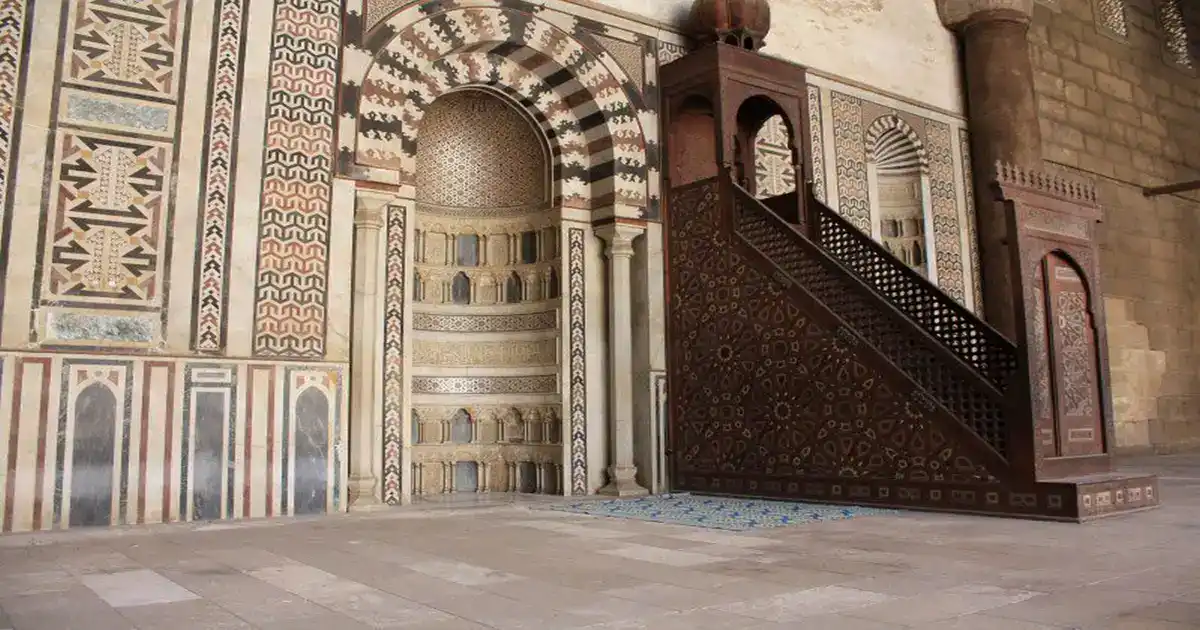
Inside the main prayer hall, rows of arches lead toward the qibla wall — the direction of Mecca.
A beautifully decorated mihrab marks the exact orientation for prayer.
Symbolism and Design Philosophy
Islamic architecture often reflects spiritual principles, and the mosque of Ahmad Ibn Tulun is no exception.
Geometry dominates the visual language of the building. Repeating patterns symbolize divine order, while the open courtyard represents the connection between earth and sky.
The mosque’s simplicity is intentional.
Instead of overwhelming decoration, the structure emphasizes proportion, light, and rhythm — qualities that encourage contemplation.
Architects and historians often study the Ahmad Ibn Tulun Mosque plan as one of the earliest examples of monumental Islamic urban design.
What Makes Ahmad Ibn Tulun Mosque Unique in Cairo
Cairo is home to hundreds of historic mosques, yet the Ahmad Ibn Tulun Mosque stands apart in several ways.
Differences from Other Cairo Mosques
Most historic mosques in Cairo belong to later architectural periods such as the Fatimid, Ayyubid, or Mamluk eras.
These mosques often feature elaborate stone carvings, towering portals, and intricate domes.
The mosque of Ahmad Ibn Tulun in Cairo, however, reflects a much earlier architectural philosophy.
Its design prioritizes scale and harmony rather than ornate decoration.
Another rare feature is its extraordinary preservation. While many mosques have undergone heavy reconstruction, this one retains much of its original 9th-century structure.
Cultural and Historical Significance
The mosque also played an important role beyond religion.
Throughout history, it served as a gathering place for scholars, travelers, and political figures.
In modern times, it has appeared in several films and historical documentaries due to its remarkably authentic atmosphere.
Today, it remains one of the most atmospheric places in Cairo — a quiet oasis in the middle of a vibrant, chaotic city.
Visiting the Mosque of Ahmad Ibn Tulun in Cairo
Planning a visit to the Ahmad Ibn Tulun Mosque Cairo is surprisingly easy.
Location and How to Get There
The mosque sits in the Sayyida Zaynab district of historic Cairo, not far from the famous Citadel.
It’s easily accessible by taxi or guided tours. Many travelers combine their visit with nearby Islamic Cairo landmarks.
Joining organized Egypt Day Tours can simplify logistics while adding expert historical insights.
Opening Hours and Visitor Tips
The mosque is typically open daily between morning and late afternoon.
Helpful tips for visitors:
- Dress modestly (shoulders and knees covered)
- Remove shoes before entering prayer areas
- Visit early morning for the best lighting and fewer crowds
- Bring a camera — the architecture is incredibly photogenic
Climbing the spiral minaret is also highly recommended for panoramic views.
Nearby Attractions
Several remarkable sites sit within walking distance:
- The Citadel of Saladin
- The Gayer-Anderson Museum
- Historic streets of Islamic Cairo
Many visitors explore the area as part of curated Cairo Day Tours, which connect these landmarks into a deeper historical narrative.
Experiencing Islamic Cairo Around Ahmad Ibn Tulun Mosque
One of the joys of visiting the Ahmad Ibn Tulun Mosque is exploring the neighborhood around it.
Historic Streets and Hidden Gems
Just steps from the mosque lies a maze of historic streets filled with traditional houses, small workshops, and local cafés.
The nearby Gayer-Anderson Museum, located in two beautifully restored Ottoman houses, offers fascinating insight into Cairo’s domestic architecture.
Wandering through this district feels like traveling through layers of history.
Best Walking Routes in the Area
A perfect walking route might include:
- Start at Ahmad Ibn Tulun Mosque
- Visit the Gayer-Anderson Museum
- Continue toward the Citadel of Saladin
- Finish in the vibrant markets of Islamic Cairo
The route reveals how the city evolved across centuries — from early Islamic architecture to medieval fortifications and bustling bazaars.
For travelers seeking deeper cultural immersion, exploring the area with a knowledgeable guide can transform a simple visit into an unforgettable journey through Cairo’s past.
Conclusion
The Ahmad Ibn Tulun Mosque is far more than a historic building — it’s a living piece of Cairo’s story. Its vast courtyard, distinctive spiral minaret, and remarkable preservation offer visitors a rare glimpse into the early centuries of Islamic architecture.
Whether you’re passionate about history, fascinated by architecture, or simply searching for authentic experiences in Cairo, this mosque delivers something special.
Many travelers include it as a highlight of curated Egypt Day Tours or immersive Cairo Day Tours, where expert guides reveal the hidden details that make the site truly extraordinary.
Stand in the quiet courtyard for a moment, look up at the arches, and imagine the generations who have walked here before you. The Ahmad Ibn Tulun Mosque remains one of Cairo’s most timeless and inspiring landmarks.
Ahmad Ibn Tulun Mosque – FAQ
1. Where is Ahmad Ibn Tulun Mosque located?
The mosque is located in the Sayyida Zaynab district of historic Cairo, near the Citadel. It’s easily accessible by taxi or through organized Cairo Day Tours.
2. How old is the Mosque of Ahmad Ibn Tulun?
The mosque was completed in 879 CE, making it one of the oldest and best-preserved mosques in Egypt.
3. Can visitors climb the minaret?
Yes. Visitors can climb the spiral minaret, which offers stunning views over historic Cairo and surrounding neighborhoods.
4. What is special about the Ahmad Ibn Tulun Mosque architecture?
Its design reflects Abbasid architecture with brick construction, geometric decoration, and a massive courtyard — a rare style in Cairo.
5. Is Ahmad Ibn Tulun Mosque worth visiting?
Absolutely. The mosque is considered one of Cairo’s most impressive historic landmarks and is often included in curated Egypt Day Tours exploring Islamic Cairo.